Etiologies: Motor vehicle accidents (MVAs, ~40%), falls (common in elderly), acts of violence/penetrating trauma, diving/sports injuries.
Risk Factors: Male sex (16–30 y/o), cervical spondylosis/stenosis (predisposes to central cord syndrome), osteoporosis, non-compliance with seatbelts.
Clinical Features
General Signs: Motor weakness/flaccid paralysis, sensory loss below injury level, absent DTRs (acute), urinary/fecal incontinence or retention.
Neurovascular States:
Spinal Shock: Transient physiologic loss of all cord function below lesion; flaccid paralysis, areflexia, and loss of autonomic tone. Resolution marked by return of bulbocavernosus reflex.
Neurogenic Shock (injuries at ≥ T6): Loss of sympathetic tone → classic triad: Hypotension, Bradycardia, and Warm/flushed extremities (distributive shock).
Incomplete Cord Syndromes:
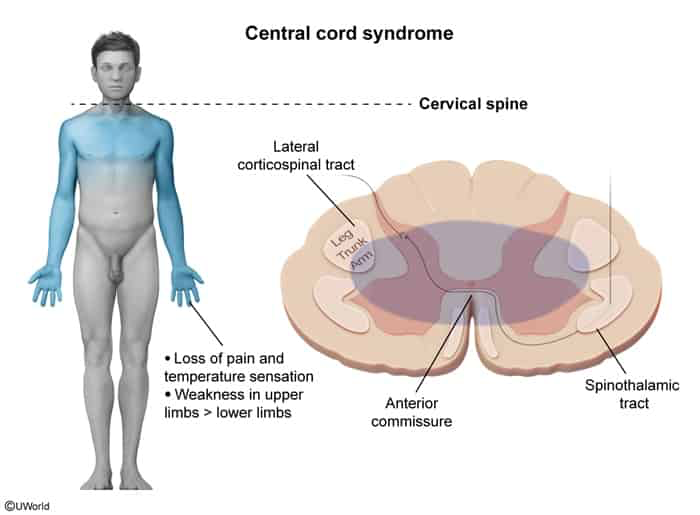
Central Cord Syndrome:
Mechanism: Hyperextension (eg, head impacting an expanded airbag) in elderly with pre-existing cervical spondylosis.
Presentation: Upper extremity weakness & sensory deficit > Lower extremity (corticospinal/spinothalamic fibers arranged somatotopically: arms medial, legs lateral). c
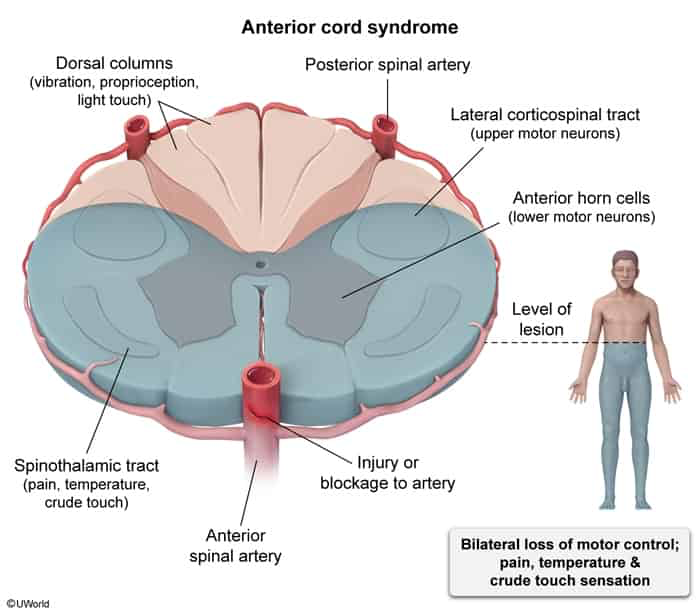
Presentation: Bilateral loss of motor function (corticospinal) and pain/temperature (spinothalamic) below level; preserved vibration and proprioception (dorsal columns spared).
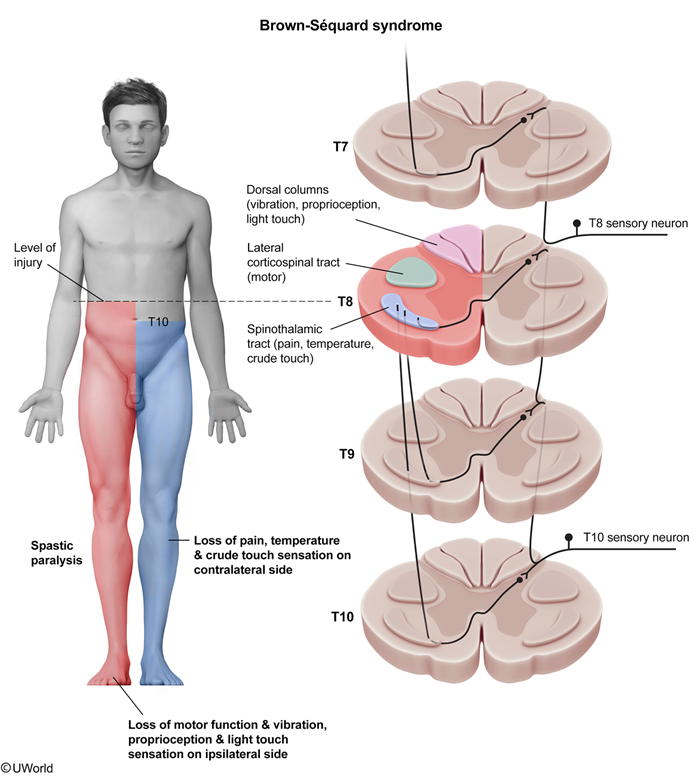
Brown-Séquard Syndrome (Hemicord transection):
Mechanism: Penetrating trauma (e.g., stab wound).
Presentation: Ipsilateral motor loss, vibration/proprioception loss; Contralateral pain/temperature loss starting 1–2 levels below the lesion.
Deficits: Pure LMN signs (hyporeflexia, flaccid weakness), saddle anesthesia, late bowel/bladder dysfunction, severe radicular pain.
Diagnosis
Initial/Screening:
Clinical clearing using NEXUS Criteria or Canadian C-Spine Rule (alert, no midline cervical tenderness, no focal neuro deficit, no intoxication, no painful distracting injury).
Non-contrast CT spine: Initial imaging of choice for trauma with suspected bony injury or spinal instability.
Confirmatory / Gold Standard (Soft Tissue & Cord):
MRI Spine: Gold standard to assess spinal cord parenchymal damage, cord compression, ligamentous tears, epidural hematoma, and herniated discs.
Key Labs & Adjuncts:
ABG / Serial vital capacity / NIF (mandatory if lesion ≥ C5 due to diaphragm paralysis risk).
Diff: Rapidly progressive cord compression after lumbar puncture, epidural anesthesia, or minor trauma in anticoagulated pts; urgent MRI required.
Transverse Myelitis:
Diff: Non-traumatic, post-infectious or autoimmune (e.g., MS); presents with rapid bilateral motor/sensory/autonomic dysfunction with a distinct sensory level and band-like thoracic sensation.
Guillain-Barré Syndrome (GBS):
Diff: Ascending symmetrical flaccid paralysis with hyporeflexia, but lacks a discrete spinal cord sensory level; CSF demonstrates albuminocytologic dissociation.
Spinal Epidural Abscess:
Diff: Classic triad of fever, focal back pain, and neurologic deficits; elevated ESR/CRP; history of IVDU or systemic infection.
Airway/Breathing: Immediate immobilization with rigid cervical collar; perform endotracheal intubation via video laryngoscopy or fiberoptic bronchoscopy with manual in-line stabilization if C3–C5 injury or respiratory distress.
Circulation / Hemodynamics:
Target MAP ≥ 85–90 mmHg for the first 5–7 days to prevent secondary cord ischemia.
Treat neurogenic shock with IV crystalloids followed by vasopressors with α1 and β1 activity (e.g., Norepinephrine, Dopamine, or Phenylephrine for pure vasodilation). Treat severe bradycardia with Atropine.
High-dose Methylprednisolone: Not recommended routinely (no significant long-term clinical benefit; increases risk of GI hemorrhage, sepsis, and infection).
4. Supportive Care & Secondary Prevention:
Foley catheter placement immediately for urinary retention.
DVT/PE prophylaxis: Intermittent pneumatic compression devices acutely → add LMWH once intracranial/spinal hemorrhage ruled out (start within 72 hrs).
Stress ulcer prophylaxis (PPI or H2RA) in high-risk cervical/high-thoracic cord injuries.
Complications
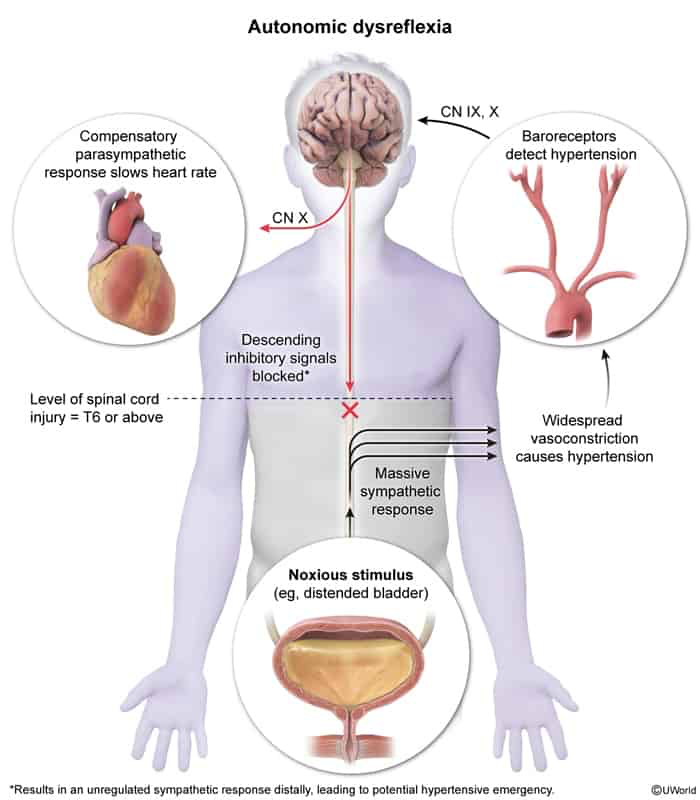
Autonomic Dysreflexia (Injuries at or above T6): c
Mechanism: Noxious stimulus below lesion level (most commonly distended bladder/blocked Foley or fecal impaction) → uninhibited sympathetic response below lesion → severe vasoconstriction → severe HTN. Intact parasympathetic response above lesion (via vagus nerve) causes compensatory bradycardia, diaphoresis, and flushing above the level of injury.
Tx: Sit patient upright (lowers BP), loosen tight clothing, relieve underlying stimulus (irrigate/place Foley, check for impaction); use rapid-acting antihypertensives (e.g., Nitropaste, Hydralazine) if SBP remains elevated.
Neurogenic Bladder: Acute flaccid/retention → chronic spastic/hyperreflexic (UMN) vs. flaccid (LMN). Risk of recurrent UTIs, hydronephrosis, and nephrolithiasis.
Pressure Ulcers (Decubitus): Frequent repositioning (q2h) and specialized air-mattresses required.
Respiratory Failure / Atelectasis: Primary cause of death in chronic tetraplegia; require aggressive pulmonary toilet and assisted coughing.