Epidemiology
Etiology
Pathophysiology
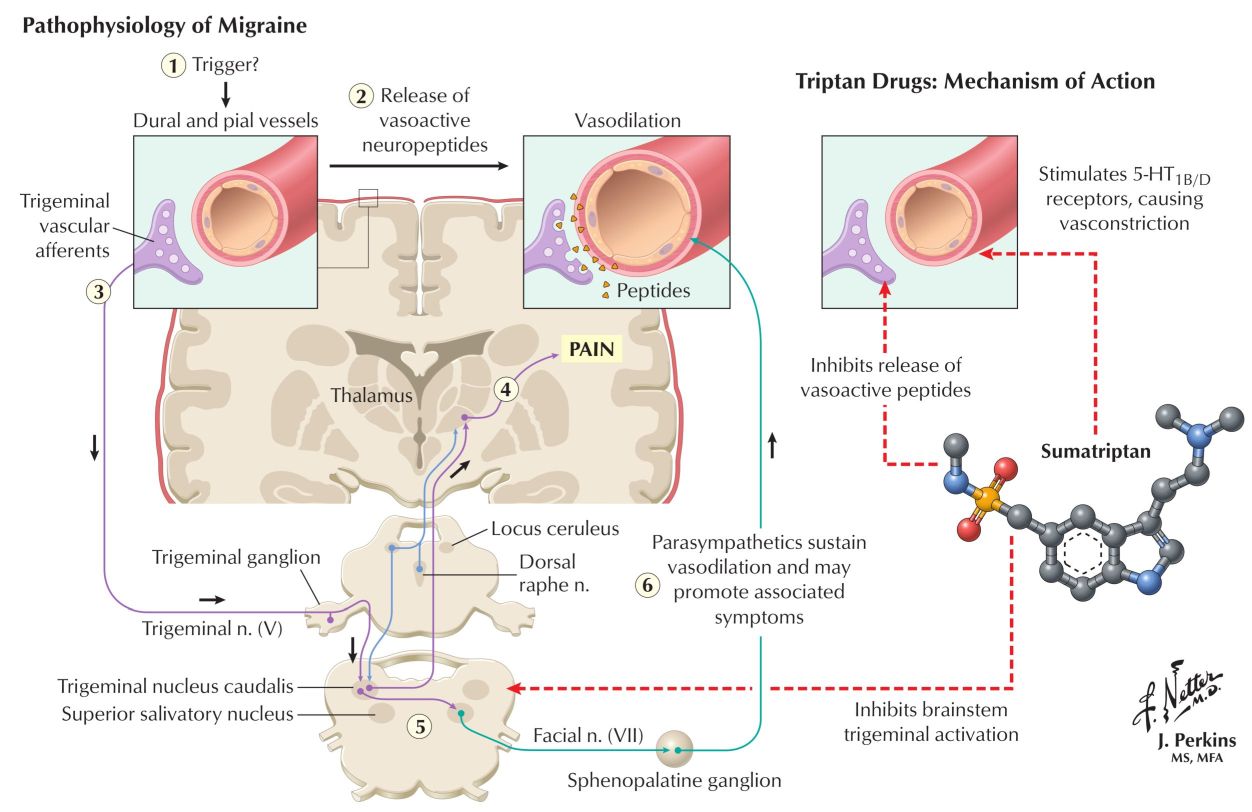
- Aura Phase: Caused by Cortical Spreading Depression (CSD), a self-propagating wave of neuronal depolarization across the cortex (~3-5 mm/min). This initial hyperactivity is followed by suppression, explaining the positive (e.g., scintillating scotoma) and negative (e.g., scotoma) features of aura.
- Pain Phase: Caused by activation of the Trigeminovascular System (TVS).
- CSD is believed to trigger the activation of trigeminal nerve afferents that innervate cranial blood vessels.
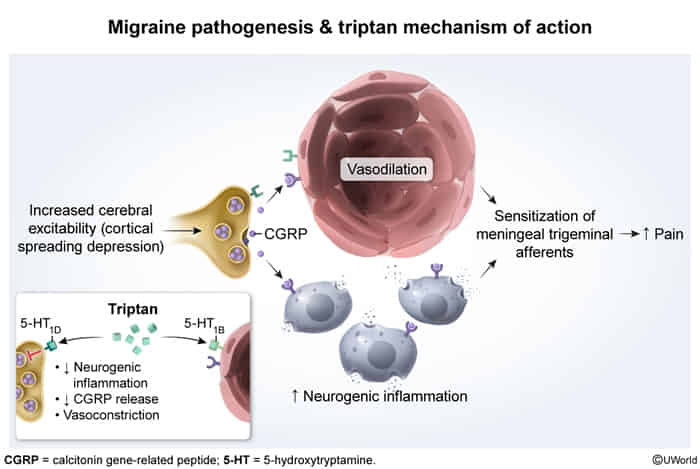
- This activation causes the release of vasoactive neuropeptides, most importantly Calcitonin Gene-Related Peptide (CGRP).
- Role of CGRP:
- CGRP is a potent vasodilator and promotes neurogenic inflammation. This leads to sensitization of pain receptors on the meningeal vessels, causing the characteristic severe, throbbing headache.
- CGRP levels are elevated during migraine attacks and normalize after successful treatment.
- Pharmacologic Targets: Triptans inhibit CGRP release, while newer CGRP antagonists directly block the peptide or its receptor.
Clinical features
- POUND Mnemonic:
- Pulsatile/throbbing quality.
- One-day duration (typically lasts 4–72 hours if untreated). c
- Unilateral location.
- Nausea and/or vomiting.
- Disabling intensity (moderate to severe), aggravated by routine physical activity.
- Associated with photophobia (sensitivity to light) and phonophobia (sensitivity to sound).
- Phases: Can include a prodrome (fatigue, mood changes), aura, headache, and postdrome (feeling drained).
- Aura: Occurs in ~30% of patients. Usually transient (<60 mins) focal neurologic symptoms (e.g., scintillating scotoma, paresthesias) that precede or accompany the headache.
Diagnostics
- Initial & Confirmatory: Clinical diagnosis (ICHD-3 criteria; normal neurological exam).
- Neuroimaging (Brain MRI preferred / Non-contrast CT):
- Not indicated for routine migraine.
- Indicated only if “Red Flags” (SNOOP):
- Systemic symptoms (fever, weight loss, cancer, HIV).
- Neurological signs (focal deficits, papilledema, AMS).
- Onset sudden (“thunderclap” onset rule out SAH).
- Older age (>50 years at onset rule out GCA / mass).
- Pattern change (progressive worsening, positional, Valsalva-induced). c
Treatment
Abortive (Acute)
- Goal: Stop an ongoing attack.
- Mild: NSAIDs, Acetaminophen. c
- Moderate/Severe:
- Triptans (Sumatriptan):
- MOA: 5-HT1B/1D agonist → vasoconstriction & ↓neuropeptide release (e.g. CGRP).
- CI: CAD, uncontrolled HTN, stroke (risk of vasospasm).
- MOA: 5-HT1B/1D agonist → vasoconstriction & ↓neuropeptide release (e.g. CGRP).
- Ergotamines (e.g., Dihydroergotamine - DHE):
- Mechanism: Non-selective 5-HT receptor agonist; causes vasoconstriction.
- Use: For moderate to severe attacks, often when triptans fail or are contraindicated.
- CGRP Antagonists (-gepants): Ubrogepant, Rimegepant. Good alternative if triptans are contraindicated.
- Triptans (Sumatriptan):
- Adjunct: Antiemetics (Prochlorperazine, Metoclopramide) for N/V.
- Key Pitfall: Avoid using >2-3 days/week to prevent Medication Overuse Headache (MOH).
Prophylactic (Preventive)
- Goal: Reduce frequency & severity.
- Indications: ≥4 headache days/month, disabling attacks.
- First-Line Agents: c4
- Beta-blockers: Propranolol.
- Anticonvulsants: Topiramate, Valproate (teratogenic).
- TCAs: Amitriptyline.
- Newer & Second-Line:
- Anti-CGRP Monoclonal Antibodies: (e.g., Erenumab). First-line option specifically designed for migraine prevention.
- Botox: For chronic migraine (≥15 headache days/month) only.
Tip
- Triptans act on downstream events of an active attack (pain-pathway activation, neurogenic inflammation, vasodilation).
- They do not change the underlying migraine threshold, which is neuronal/cortical hyperexcitability and the trigger for the attack.
- Prophylaxis must lower attack frequency by chronic modulation of that threshold. Triptans don’t do this.