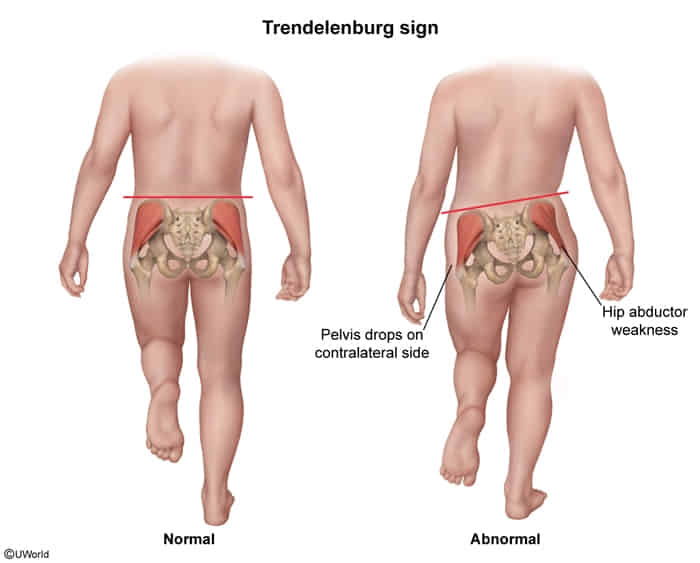
Test for neurological insufficiency of the gluteus medius and gluteus minimus muscles, which are innervated by the superior gluteal nerve
Examination
The patient is asked to stand on one leg.
Interpretation
Negative Trendelenburg sign (physiological): The pelvis remains level as it is stabilized by the gluteus medius and minimus.
Positive Trendelenburg sign (pathological): Because of insufficiency of the gluteus medius and minimus on the side of the standing leg, the pelvis drops towards the contralateral, unimpaired side.
Duchenne sign: The torso tilts toward the contralateral side, compensating the pelvic drop on the unimpaired side.
Duchenne limp: The Duchenne sign, which frequently occurs bilaterally, results in a compensatory to‑and‑from movement of the torso during walking.
Causes
Iatrogenic Nerve Injury:
Posterior/lateral surgical approach to Total Hip Arthroplasty (THA).
Intramuscular (IM) injections in the dorsogluteal region (safe zone: anterolateral / superolateral quadrant).