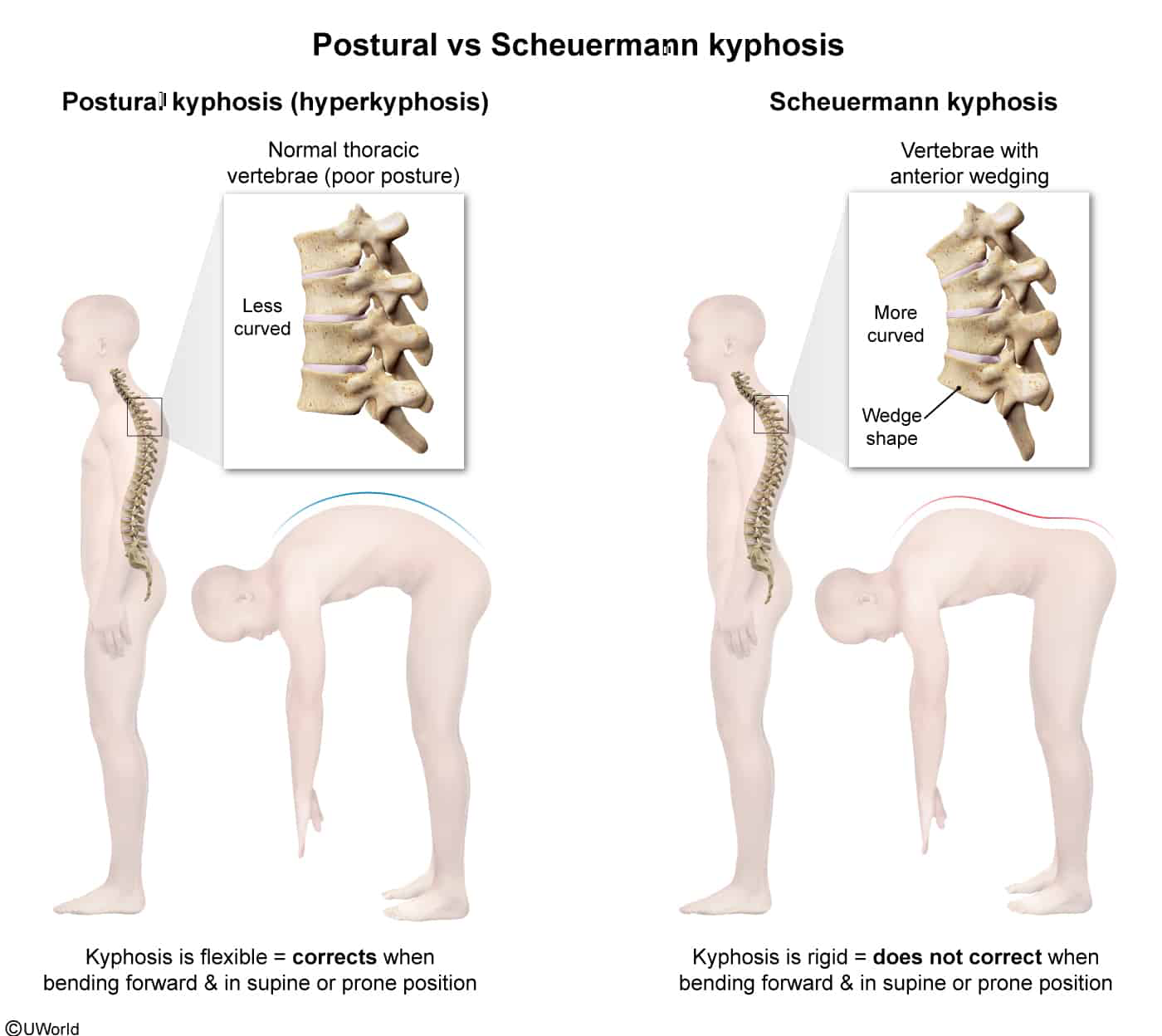
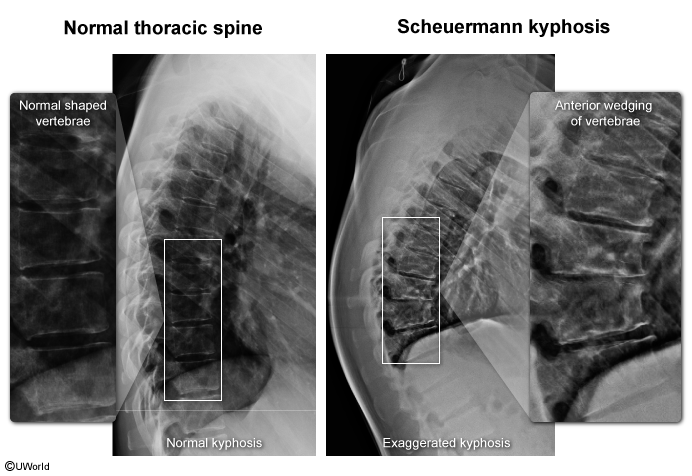
Demographics: Adolescents during pubertal growth spurt (typically 12–17 yo); slight male predominance (M > F or M = F).
Pathophysiology: Osteochondrosis of secondary ossification centers in vertebral ring apophyses → abnormal endplate development → anterior wedging of vertebral bodies.
Risk Factors: Positive family history (autosomal dominant inheritance pattern suspected with variable expressivity), repetitive mechanical stress/axial loading.
Clinical Features
History:
Insidious onset of dull, non-radiating mid-to-lower thoracic back pain.
Pain worsened by prolonged sitting, standing, or physical activity; relieved by rest.
Schmorl nodes (herniation of nucleus pulposus through weakened vertebral endplates).
Irregular/flattened vertebral endplates and narrowed intervertebral disc spaces.
Key Labs: Normal (ESR, CRP, CBC normal; indicated only to exclude infection or inflammatory arthropathy).
Advanced Imaging (MRI): Reserved for pts with atypical pain, neurological symptoms, or pre-op planning.
Differential Diagnostics
Postural Kyphosis (Postural Roundback):
Differentiating features: Flexible curve (fully corrects with voluntary extension or prone hyperextension); smooth contour on forward bend; normal XR without anterior wedging or Schmorl nodes.
Congenital Kyphosis:
Differentiating features: Appears in infancy/early childhood; caused by failure of formation (hemivertebra) or failure of segmentation (unsegmented bar); rapid progression; high risk of neurologic deficit.
Ankylosing Spondylitis:
Differentiating features: Presents in late adolescence/young adulthood with inflammatory back pain (morning stiffness > 30 min, improves with exercise); (+) HLA-B27, elevated ESR/CRP; bilateral sacroiliitis on pelvic XR/MRI.
Tuberculous Spondylitis (Pott Disease):
Differentiating features: Constitutional signs (fever, night sweats, weight loss); systemic TB exposure; focal lytic destruction of disc and adjacent vertebrae on XR/MRI.
Management
Mild / Asymptomatic (Curve < 60° and skeletally mature or immature):
First-line: Observation with serial clinical and XR exams every 4–6 months until skeletal maturity.
Physical therapy (PT) for extensor muscle strengthening, hamstring stretching, and core stability.