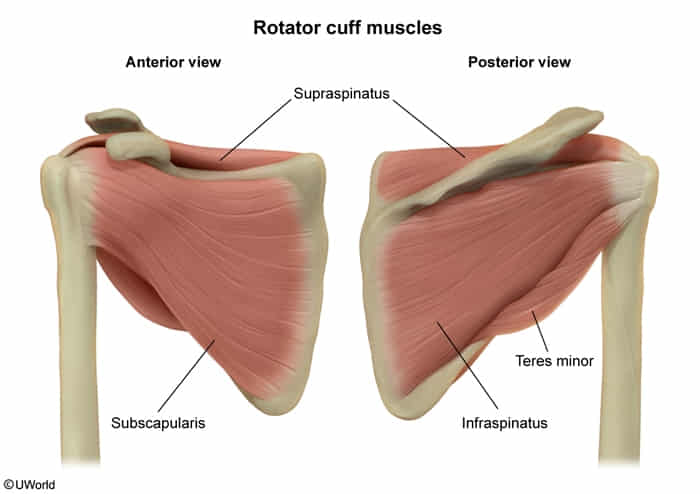
 (View in the front)
 (like you put your hand on someone’s shoulder from the back)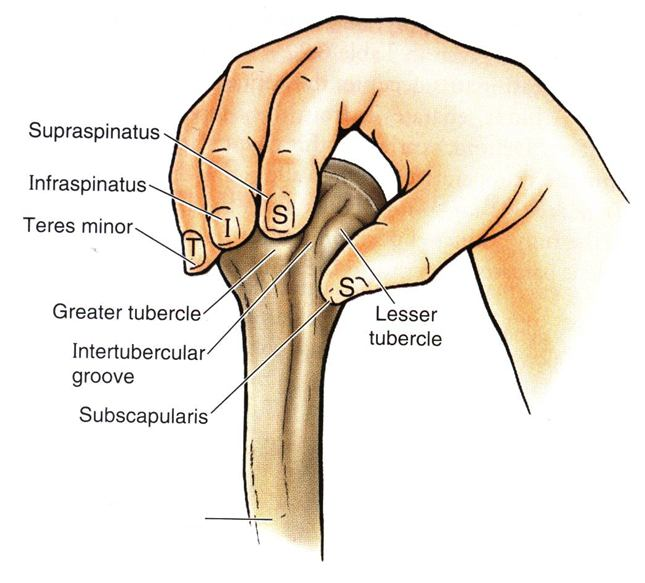
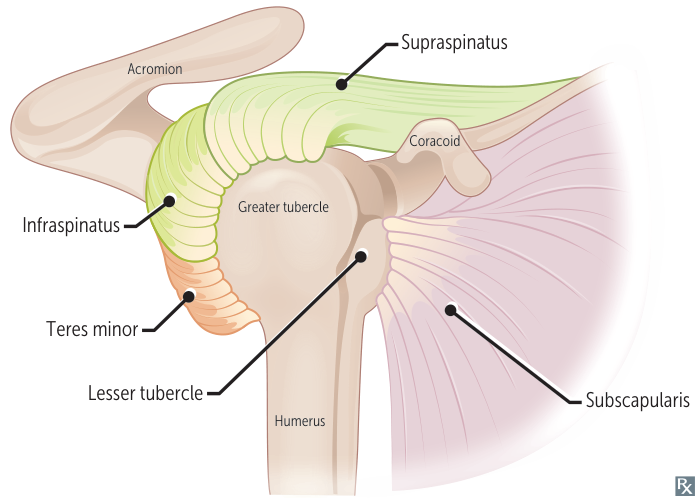
- Supraspinatus (suprascapular nerve)
- Abducts arm initially (before the action of the deltoid)
- Most common rotator cuff injury (trauma or degeneration and impingement leading to tendinopathy or tear)
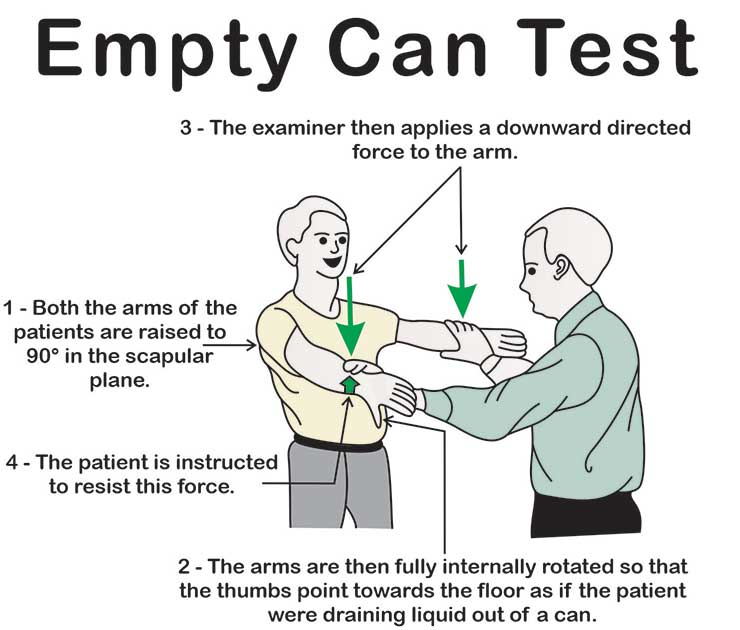
- Assessed by the “empty/full can” test
- Infraspinatus (suprascapular nerve)
- Externally rotates arm
- The only one of these four muscles that does not participate in abduction.
- Common pitching injury
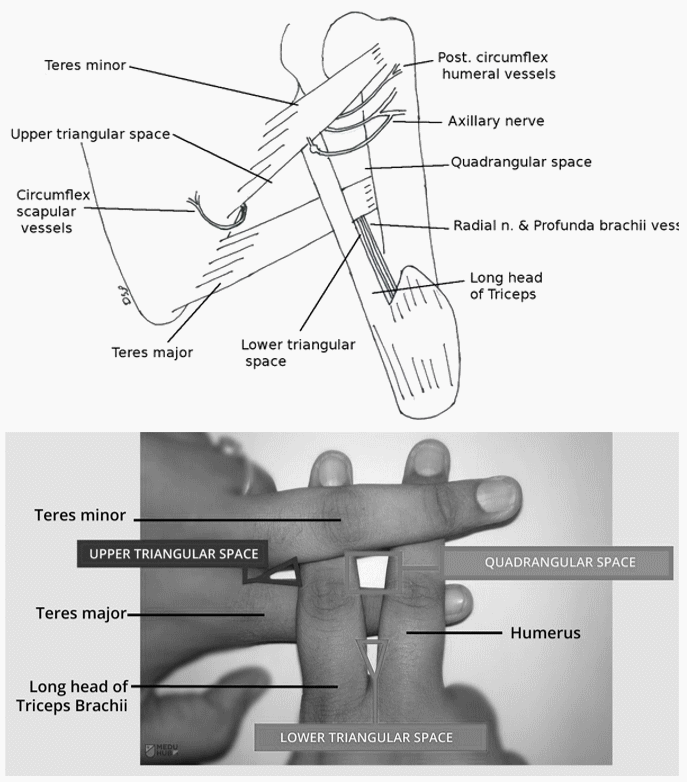
- Teres minor (axillary nerve)
- Adducts and externally rotates arm
- Subscapularis (upper and lower subscapular nerves)
- Internally rotates and adducts arm (only one responsible for internal rotation t)
- Subscapularis tendinopathy
Abduction of the upper limb
- (0°-15°) Abduction of the upper extremity is initiated by the supraspinatus muscle (suprascapular nerve).
- (15°-110°) Further abduction to the horizontal position is a function of the deltoid muscle (axillary nerve).
- (110°-180°) Raising the extremity above the horizontal position requires scapular rotation by action of the trapezius (accessory nerve CN XI) and serratus anterior (long thoracic nerve).
Mnemonic
“Start Dancing, Then Spin!”
- Start (Supraspinatus: 0°–15°)
- Dancing (Deltoid: 15°–110°)
- Then (Trapezius: 110°–180°)
- Spin! (Serratus anterior: 110°–180°)
Rotator cuff tear
- Etiology & Risk Factors:
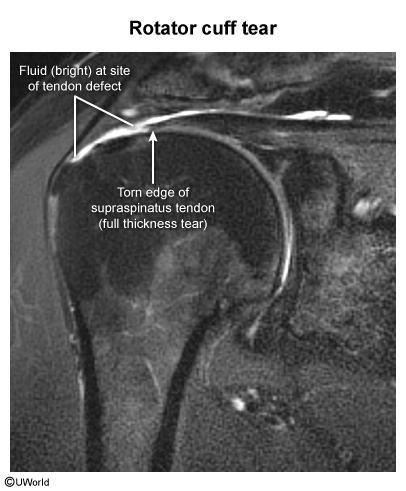
- Supraspinatus tendon most commonly affected (watershed area). c
- Degenerative tears: Age > 40, repetitive overhead activities (painters, pitchers).
- Acute traumatic tears: Fall on outstretched hand (FOOSH), anterior shoulder dislocation.
- Clinical Presentation:
- Anterolateral/lateral shoulder pain exacerbated by overhead motion and lying on affected side at night.
- True motor weakness and catch/crepitus during active elevation.
- Physical Examination:
- Decreased active ROM with preserved passive ROM (hallmark).
- Supraspinatus: Positive Drop arm test and Empty-can (Jobe) test. c
- Infraspinatus / Teres minor: Weakness on resisted external rotation, external rotation lag sign.
- Subscapularis: Weakness on resisted internal rotation, positive Lift-off test.
- Diagnosis:
- Initial test: X-ray shoulder (AP, axillary, scapular Y) to rule out fracture/OA; chronic tears show superior humeral head migration.
- Confirmatory / Gold standard: MRI shoulder without contrast (determines partial vs. full-thickness, size, retraction, and muscle atrophy).
- Diagnostic maneuver: Subacromial lidocaine injection (relieves pain; persistent true weakness confirms tear vs. tendinopathy).
- Differential Diagnosis:
- Rotator cuff impingement/tendinopathy: Painful arc (60°–120°), normal strength once pain is relieved with lidocaine.
- Adhesive capsulitis (Frozen shoulder): Loss of both active AND passive ROM in all planes.
- Cervical radiculopathy (C5–C6): Pain radiates below elbow, positive Spurling sign, dermatomal sensory loss.
- Management:
- First-line (Conservative): NSAIDs, activity modification, physical therapy (PT) ± subacromial corticosteroid injection (indicated for partial tears, degenerative tears in low-demand/elderly pts).
- Surgical repair: Indicated for acute traumatic full-thickness tears in young/active pts (ideally within 6 weeks) or failure of conservative therapy after 3–6 months.
- Refractory / Chronic end-stage: Reverse total shoulder arthroplasty (rTSA) for rotator cuff tear arthropathy.
- Complications:
- Irreversible muscle atrophy and fatty infiltration (worsens surgical prognosis).
- Rotator cuff tear arthropathy (secondary glenohumeral osteoarthritis).
Adhesive capsulitis
- Definition & Pathophysiology:
- Chronic inflammation, capsular thickening, and fibrosis causing contracture of the glenohumeral joint.
- Risk Factors:
- DM (strongest association; up to 20%, often bilateral) and hypothyroidism.
- Shoulder immobilization (post-CVA, post-op, trauma), female sex (age 40–65).
- Clinical Presentation:
- Insidious dull shoulder pain (worse at night) with progressive stiffness.
- Phases: Freezing (pain > stiffness) Frozen (stiffness > pain) Thawing (gradual ROM resolution).
- Physical Exam (Exam Hallmark):
- ↓ Active AND passive ROM in multiple planes.
- External rotation and abduction are most severely restricted.
- Diagnosis:
- Clinical: Based on loss of active + passive ROM.
- X-ray: Typically normal; initial step to rule out glenohumeral OA and fractures.
- MRI: Indicated only if refractory or atypical; shows thickened capsule and contracted axillary pouch.
- Key Labs: Screen for secondary causes with HbA1c and TSH.
- High-Yield Differentials:
- Rotator cuff pathology: Passive ROM is preserved; only active ROM/strength is decreased.
- Glenohumeral OA: Active and passive ROM decreased, but X-ray demonstrates joint space narrowing/osteophytes.
- Subacromial impingement: Passive ROM is preserved; painful arc present (60°–120°).
- Cervical radiculopathy: Preserved shoulder ROM; dermatomal numbness/weakness, (+) Spurling test.
| Condition | Active ROM | Passive ROM |
|---|---|---|
| Adhesive capsulitis | ↓ | ↓ |
| Rotator cuff tear | ↓ | Preserved |
| Axillary nerve injury | ↓ abduction | Preserved |
| Cervical radiculopathy | Variable | Preserved |
- Management:
- First-line: Gentle daily stretching/PT + NSAIDs or acetaminophen.
- Second-line: Intra-articular glucocorticoid injection (best for persistent/severe pain; accelerates ROM recovery when combined with PT).
- Refractory (> 6–12 months): Closed manipulation under anesthesia (MUA) or arthroscopic capsular release.