- Anatomy & Pathophysiology:
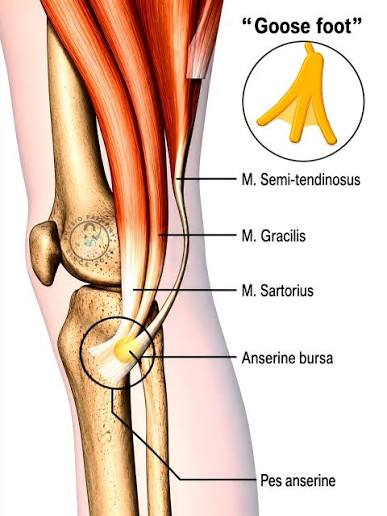
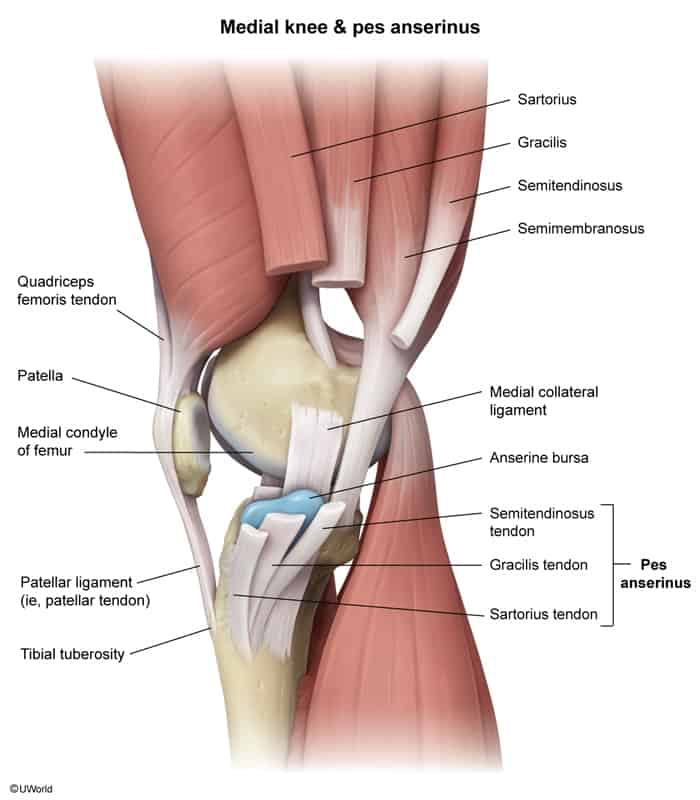
- Inflammation of the bursa deep to the conjoined tendons of Sartorius, Gracilis, Semitendinosus (“SGT / Say Grace before Tea”) at the anteromedial proximal tibia.
- Risk Factors:
- Obesity, female sex, middle-to-older age.
- Medial compartment knee OA (most common coexisting factor).
- Overuse/repetitive knee flexion (e.g., runners, cyclists).
- Malalignment (genu valgum, pes planus) and DM.
- Clinical Presentation:
- Subacute/chronic localized pain over the anteromedial proximal tibia. c
- Aggravated by climbing stairs, rising from a chair, or nocturnal knee-on-knee pressure.
- PE: Point tenderness ~4–5 cm distal to medial joint line.
- No true intra-articular effusion, full ROM, (-) McMurray test, (-) Valgus laxity.
- Diagnosis:
- Clinical diagnosis (no labs or routine imaging required).
- Knee XR: Normal for bursa; rules out underlying OA or fracture.
- MSK-US/MRI: Reserved for refractory or atypical cases.
- High-Yield Differentials:
- Medial Meniscal Tear: Tenderness strictly along the medial joint line, mechanical locking/catching, (+) McMurray, (+) joint effusion.
- MCL Sprain/Tear: Acute valgus trauma history, pain/laxity with valgus stress test.
- Tibial Stress Fracture: Focal tenderness over tibial cortex/shaft, localized edema on MRI/XR.
- Management:
- First-line: Conservative therapy (oral/topical NSAIDs, ice, activity modification, PT for hamstring/quadriceps stretching, weight loss). c
- Second-line / Refractory: Local intrabursal corticosteroid injection (triamcinolone + lidocaine).