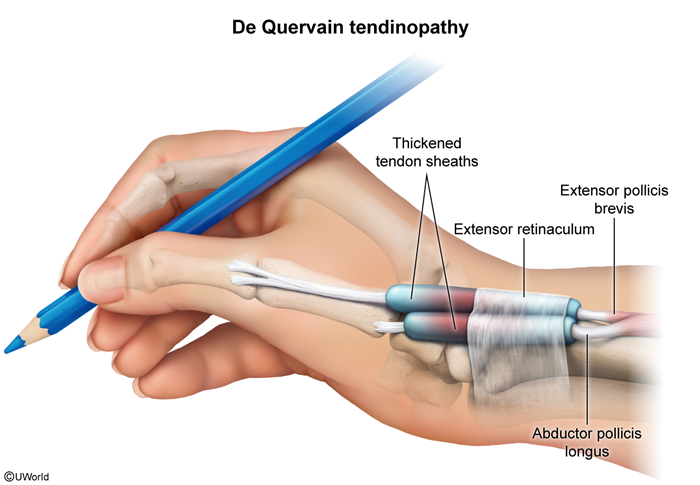
Pain and tenderness localized directly over the radial styloid and 1st dorsal compartment.
Pain worsened by pinching, grasping, or active thumb abduction/extension.
Positive Finkelstein Test: Severe pain elicited when the thumb is folded inside a clenched fist and the wrist is passively deviated toward the ulnar side. c
Stenosing Tenosynovitis (Trigger Finger):
Painful clicking, locking, or “catching” of the affected digit during active flexion/extension.
Palpable, tender nodule over the flexor tendon sheath at the level of the MCP joint (A1 pulley).
Digit may lock in flexion, requiring passive manipulation to straighten.
Systemic / Inflammatory Presentation:
Dactylitis (“sausage digit”): Diffuse swelling of an entire digit involving tendon sheaths and joints; classic for PsA and reactive arthritis.
Clinical Diagnosis: Established via history and physical exam findings (e.g., positive Finkelstein test, palpable catching flexor nodule). c
Imaging:
Plain Radiographs (X-ray): Initial test to rule out bony pathology (e.g., scaphoid fracture, 1st CMC osteoarthritis). Findings in tenosynovitis are typically normal.
High-Resolution Musculoskeletal US: High sensitivity; demonstrates tendon sheath thickening, peri-tendinous fluid accumulation, and dynamic tendon entrapment.
MRI: Reserved for diagnostic ambiguity, atypical presentations, or surgical planning.
Key Labs:
Generally normal in isolated overuse syndromes.
ESR, CRP, RF, anti-CCP, HLA-B27 indicated if systemic inflammatory arthritis is suspected.
Differential Diagnostics
Infectious (Purulent) Flexor Tenosynovitis:
Diff by presence of Kanavel Four Cardinal Signs (uniform sausage digit, held in slight flexion, tenderness along flexor sheath, severe pain on passive extension), systemic fever, and acute onset. Surgical emergency.
Diff by localized tenderness at the base of the thumb (proximal to radial styloid), positive Thumb Grind test (axial loading + rotation), and joint space narrowing/osteophytes on X-ray.
Scaphoid Fracture:
Diff by history of FOOSH (fall on outstretched hand), localized tenderness in the anatomical snuffbox (dorsal/radial side between EPB/APL and EPL), and fracture line on scaphoid view X-ray.
Carpal Tunnel Syndrome (CTS):
Diff by paresthesias/numbness in median nerve distribution (palmar thumb, index, middle, and radial half of ring finger), positive Phalen/Tinel signs, and thenar atrophy.
Intersection Syndrome:
Diff by pain and palpable crepitus located ~4 cm proximal to Lister tubercle/radial styloid on the dorsum of the forearm (not directly at the radial styloid).
Management
First-Line (Conservative):
Activity modification and resting the affected extremity.
Immobilization:
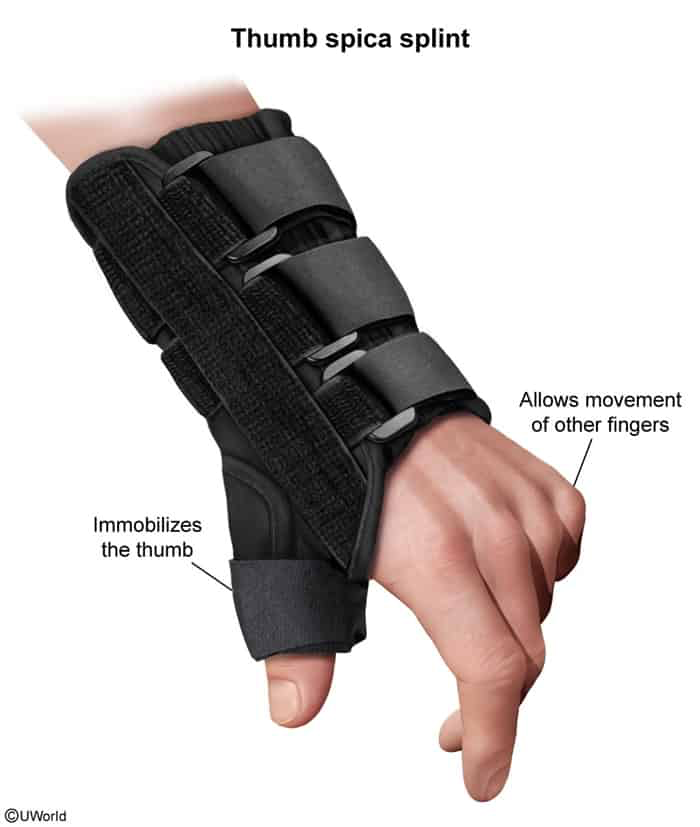
Thumb spica splint for De Quervain tenosynovitis.
Custom extension splinting for trigger finger.
Oral NSAIDs (e.g., Ibuprofen, Naproxen) or topical NSAIDs for analgesia.
PT / Occupational therapy.
Second-Line:
Local Corticosteroid Injection: Intrasheath injection of glucocorticoid + local anesthetic (e.g., Methylprednisolone or Triamcinolone). High efficacy (70–80% resolution).
Refractory / Surgical:
Repeat corticosteroid injection (limit to 1–2 injections to avoid complications).
Surgical Decompression:
Surgical release of the 1st dorsal extensor compartment for De Quervain tenosynovitis.
Percutaneous or open A1 pulley release for trigger finger.
Complications
Chronic Pain & Disability: Persistent loss of grip/pinch strength and reduced range of motion.