Epidemiology & Risk Factors
- Demographics: Adolescent Idiopathic Scoliosis (AIS, age yo) is most common (~80%). c
- Sex: Overall equal incidence; F:M ratio ~10:1 for severe, progressive curves.
- Risk Factors for Progression:
- Female sex.
- High remaining skeletal growth potential: Early Tanner stage (1–2), premenarchal status, open triradiate cartilage, low Risser grade (0–2). c
- Initial curve magnitude: Cobb angle .
Clinical Features
- Presentation: Painless, incidental trunk/shoulder/waist asymmetry.
- Physical Exam:
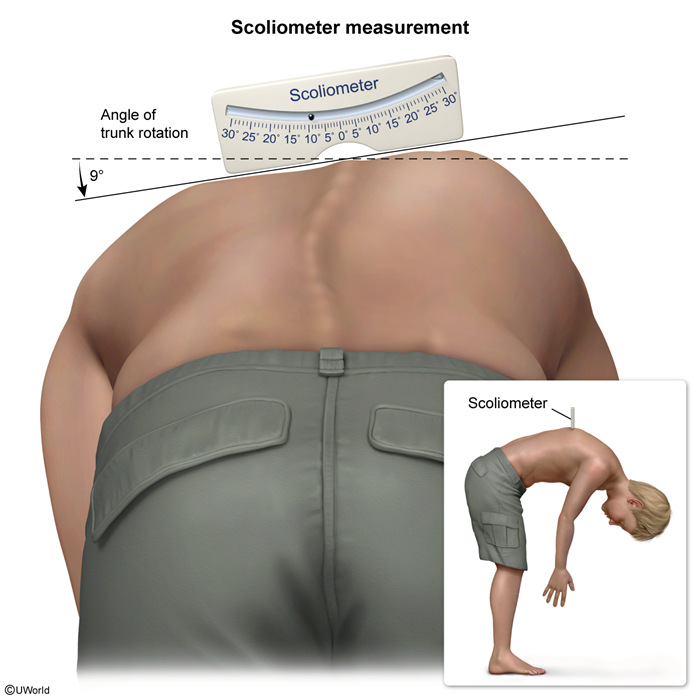
- Adam’s Forward Bend Test: Demonstrates rotational deformity / unilateral rib hump.
- Scoliometer: ATR warrants imaging.
- Red Flags (requires Spinal MRI for non-idiopathic causes): c
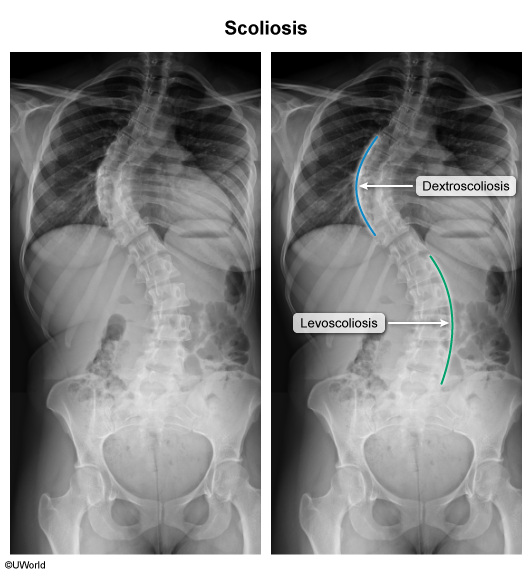
- Left-sided thoracic curve (levoscoliosis).
- Neurologic signs (hyperreflexia, clonus, sensory loss).
- Severe or nocturnal back pain; rapid progression.
Diagnosis
- Initial/Screening: Adam’s forward bend test scoliometer.
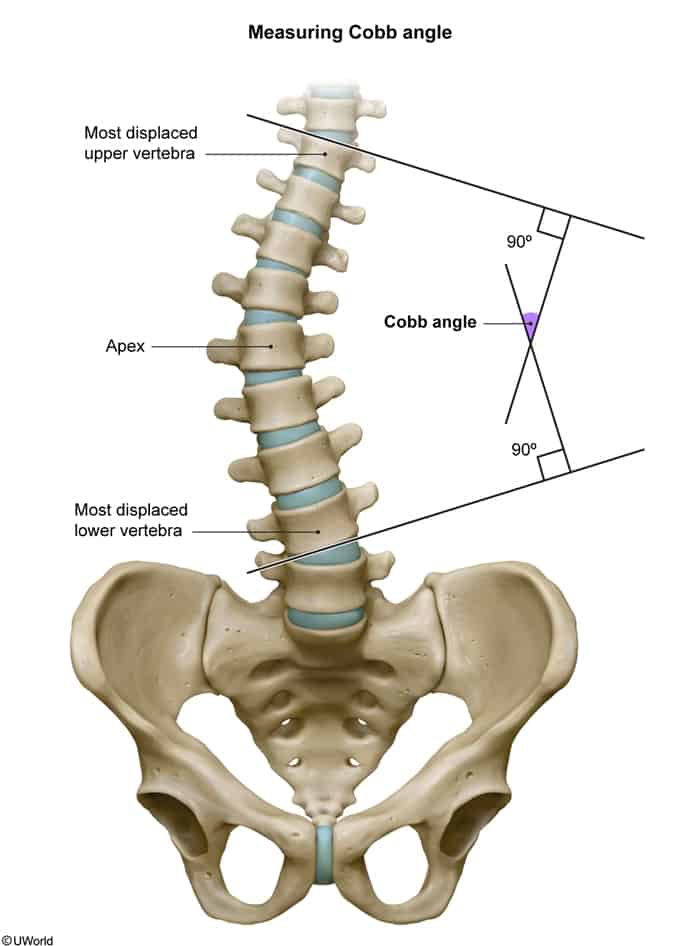
- Confirmatory / Gold Standard: Standing full-length spine XR (PA and lateral). c
- Diagnostic threshold: Cobb angle with vertebral rotation.
- Risser staging (0–5): Evaluates iliac crest ossification for skeletal maturity.
- Diagnostic threshold: Cobb angle with vertebral rotation.
- Other Studies:
- Spine MRI: Indicated only if red flags are present.
- PFTs: Assess for restrictive lung disease if Cobb angle .
Differential Diagnostics
- Neuromuscular (CP, DMD): Diff by underlying motor impairment, rapid progression, long C-shaped curve.
- Congenital Scoliosis: Diff by intrinsic vertebral anomalies (hemivertebrae) on XR; check VACTERL/renal US.
- Syringomyelia / Chiari I: Diff by left thoracic curve, cape-like sensory loss; diagnose via MRI.
- Osteoid Osteoma: Diff by painful curve, nocturnal pain rapidly relieved by NSAIDs.
- Postural / Functional: Diff by complete resolution of asymmetry on forward bend or sitting.
Management
-
Stratified by Cobb Angle & Skeletal Maturity:
-
Cobb Angle < 20°:
- Observation: Serial clinical exam and spine XR every 4–6 months until skeletal maturity.
-
Cobb Angle 20° – 40°:
- Bracing (TLSO): Indicated if skeletally immature (Risser 0–2) + documented progression () or baseline .
- Goal: Prevents further progression (does not correct existing curve).
-
Cobb Angle > 40° – 50°:
- Surgical Correction: Posterior spinal fusion with instrumentation (indicated for if immature, if mature).
-
Complications
- Severe Restrictive Lung Disease: Cobb angle TLC/FVC, hypoventilation, cor pulmonale.
- Chronic Lumbar Pain: Premature degenerative disc disease in untreated adults.
- Psychosocial Stress: Body image disturbance.