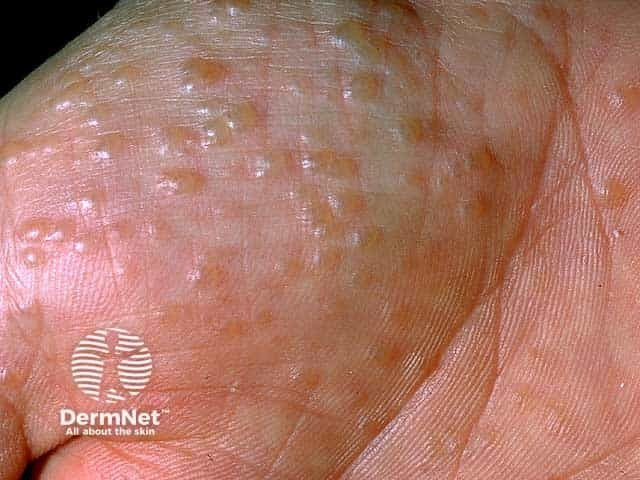
Dyshidrotic eczema
Etiology & Risk Factors
Young adults (<40 yo) with atopic diathesis (atopic dermatitis, asthma, allergic rhinitis).
Triggers: Hyperhidrosis , frequent wet work/handwashing, nickel/contact allergens , emotional stress.
Clinical Presentation
Intense pruritus or burning preceding lesions.
“Tapioca pudding” vesicles : Deep-seated, tense, clear vesicular clusters.Distribution : Lateral fingers/toes , palms, and soles (classically symmetric).Late stage: Scaling, desquamation, lichenification, and painful fissures .
Diagnosis
Clinical diagnosis based on history and characteristic lesions.KOH prep : Essential initial step to rule out dermatophyte infection (Tinea ).Patch testing: Indicated for recurrent/chronic cases to identify contact allergens.
High-Yield Differentials
Tinea manuum/pedis : (+) KOH (branching hyphae), asymmetric (“two feet, one hand”).Scabies : Nocturnal pruritus, burrows in web spaces, (+) mineral oil scraping for mites/eggs.Herpetic whitlow : Severe localized pain (not itch), single digit, (+) HSV PCR.Palmoplantar pustulosis : Primary sterile yellow pustules , not clear vesicles.
Management
General : Emollients (petrolatum), avoid harsh soaps/wet work, wear cotton gloves.1st-line : Super-high-potency topical corticosteroids (e.g., Clobetasol 0.05% ointment).Severe/Disabling : Short taper of oral corticosteroids (e.g., Prednisone).Refractory/Maintenance : Topical calcineurin inhibitors (Tacrolimus), phototherapy (PUVA/narrowband UV-B), or Dupilumab.
Complications
Secondary bacterial superinfection (most commonly Staphylococcus aureus
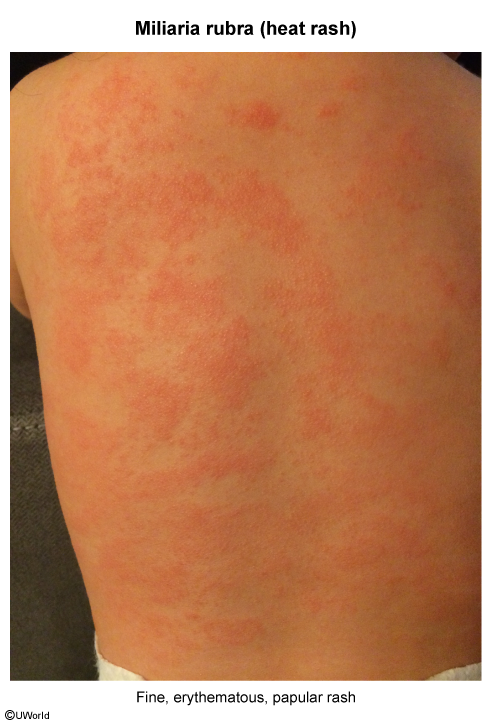
Miliaria
Pathophysiology : Occlusion of eccrine sweat ducts causing sweat extravasation into skin layers.Risk Factors : Neonates (immature sweat glands), hot/humid environments, febrile illness, over-bundling , and occlusive dressings/ointments.Clinical Variants :
Miliaria crystallina (stratum corneum): Asymptomatic, fragile 1–2 mm clear superficial vesicles without erythema (“dewdrops” ); easily ruptured by light friction.Miliaria rubra (“prickly heat”; intraepidermal): Intensely pruritic/burning , erythematous non-follicular papules and microvesicles in flexural areas and trunk.Miliaria profunda (dermal): Firm, flesh-colored, asymptomatic papules/nodules; typically follows recurrent episodes of rubra.
Key Differentials :
Erythema toxicum neonatorum : Spares palms/soles; pustules show eosinophils on Wright stain (miliaria does not).Neonatal cephalic pustulosis (neonatal acne) : Confined to face/cheeks; non-pruritic; lacks comedones.Folliculitis : Centered strictly on hair follicles (miliaria is non-follicular/eccrine).
Diagnosis : Clinical; no laboratory workup or biopsy indicated.Management :
First-line : Cooling and air exposure (AC, remove excessive/tight clothing, cool baths, avoid occlusive petroleum-based ointments).Symptomatic relief (rubra) : Low-potency topical corticosteroids (e.g., hydrocortisone 1%) or calamine lotion.Secondary superinfection : Topical mupirocin or oral anti-staphylococcal Abx (e.g., cephalexin) if secondary S. aureus impetigo develops.
Complications : Secondary bacterial infection, localized anhidrosis, and impaired thermoregulation leading to heat exhaustion/heat stroke .