Epidemiology
Etiology
- Pathogen: Mycobacterium leprae is an obligate, intracellular, acid-fast bacillus that cannot be cultured and thrives in cold temperatures.
- Route of transmission
- Close contact with fomites, contaminated soil, infected individuals, and nine-banded armadillos (in rare cases)
- Respiratory droplet transmission
- Risk factors are close contact with infected individuals or contaminated soil.
Pathophysiology
- Disease spectrum depends on the host’s cell-mediated immune response (Th1 vs. Th2).
- Tuberculoid Leprosy (Paucibacillary)
- Strong Th1 Response (High IL-2, IFN-γ).
- Macrophage activation limits bacterial growth.
- Low bacterial load.
- (+) Lepromin skin test (indicates strong immune response).
- Histology: Non-caseating granulomas.
- Lepromatous Leprosy (Multibacillary)
- Weak Th1 / Strong Th2 Response (High IL-4, IL-5, IL-10).
- Depressed cell-mediated immunity; humoral response is ineffective.
- High bacterial load.
- (-) Lepromin skin test (anergy).
- Histology: Foamy histiocytes (macrophages) packed with AFB (Virchow cells); no granulomas.
Clinical features
- Spectrum depends on host cell-mediated immunity (Th1 vs Th2 response):
- Tuberculoid Leprosy (Paucinbacillary):
- Pathophysiology: Strong Th1 (cell-mediated) response -> low bacterial load.
- Skin: Solitary/few hypopigmented, hypesthetic/anesthetic macules or plaques w/ well-demarcated raised borders and localized alopecia.
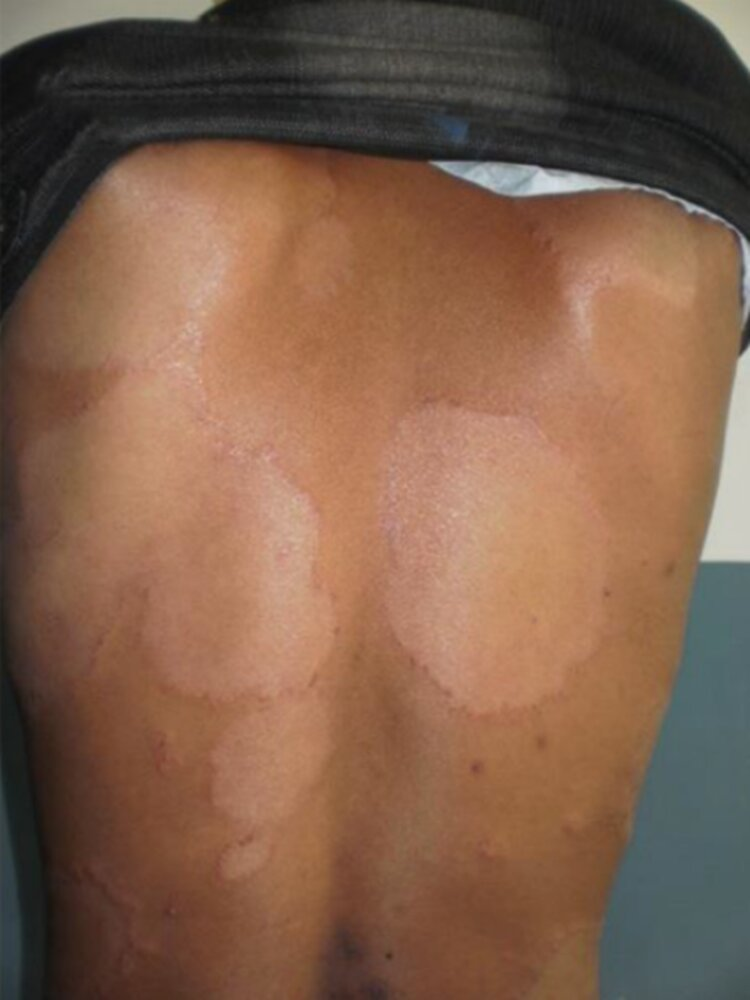
- Nerves: Asymmetric, enlarged, palpable peripheral nerves (ulnar, common peroneal, great auricular) w/ focal nerve deficits. c
- Lepromatous Leprosy (Multibacillary):
- Pathophysiology: Weak Th1 / dominant Th2 response -> high bacterial load.
- Skin: Symmetrical, widespread, poorly demarcated macules, papules, nodules, and facial skin thickening (leonine facies).
- Hair/Facial: Loss of eyebrows and eyelashes (madarosis), collapse of nasal septum (saddle nose deformity).
- Nerves: Symmetric glove-and-stocking sensorimotor neuropathy.
- Systemic: Testicular involvement (orchitis, atrophy, hypogonadism, gynecomastia).
Diagnostics
The lepromin skin test (in which M leprae antigens are injected intradermally) can be used to distinguish between tuberculoid and lepromatous leprosy. Patients with tuberculoid leprosy will develop an indurated nodule at the site of the injection (much like a positive PPD test for M tuberculosis). In contrast, the test is usually nonreactive in patients with lepromatous leprosy due to their weak TH1 cell-mediated immune response.
Differential Diagnostics
- Pityriasis Versicolor (Malassezia): Hypopigmented macules on upper trunk/arms, but sensation is intact; (+) KOH prep showing “spaghetti and meatballs” hyphae/spores.
- Vitiligo: Completely depigmented (chalk-white) macules, but sensation is intact, no nerve involvement; autoimmune loss of melanocytes.
- Sarcoidosis: Non-caseating granulomas, can cause facial nerve palsy or lupus pernio, but no localized anesthetic macules; elevated ACE, hilar adenopathy.
- Syphilis (Secondary/Tertiary): Secondary presents w/ maculopapular rash involving palms/soles; tertiary presents w/ gummas or tabes dorsalis, but no focal anesthetic skin hypopigmentation.
- Diabetic Neuropathy: Symmetric distal stocking-glove sensory loss, but no localized hypopigmented skin lesions or palpably enlarged superficial nerves.
Treatment
Dapsone
- Mechanism of action
- Competitive antagonist of para-aminobenzoic acid (PABA) for dihydropteroate synthetase → inhibition of dihydrofolic acid synthesis
- Structurally different from sulfonamides but a similar mechanism of action
- Clinical use
- M. leprae: lepromatous and tuberculoid leprosy
- P. jiroveci pneumonia
- Prophylaxis
- Treatment: used in combination with TMP as an alternative to TMP/SMX
- Adverse effects
- Methemoglobinemia
- Triggers hemolytic anemia in patients with G6PD deficiency c
- Agranulocytosis