Epidemiology & Risk Factors

  • Etiology divided into Immune (10–15%) and Non-Immune (85–90%).
  • Immune Hydrops:
    • Maternal-fetal blood group incompatibility: Rh alloimmunization (anti-D antibodies), anti-Kell, anti-E.
  • Non-Immune Hydrops:
    • Cardiovascular (~40%, most common non-immune cause): Congenital heart disease, structural malformations, arrhythmias (e.g., fetal SVT).
    • Chromosomal/Genetic: Turner syndrome (45,X) (associated w/ cystic hygroma), Trisomy 21, 18, 13.
    • Hematologic: Alpha-thalassemia major (Hb Barts: 4-gene deletion --/--), G6PD deficiency, hereditary spherocytosis.
    • Infections: Parvovirus B19 (viral destruction of erythroid progenitor cells -> severe fetal anemia), CMV, Toxoplasmosis, Syphilis. c
    • Twin-to-Twin Transfusion Syndrome (TTTS): Severe volume overload in recipient twin.

Clinical Features

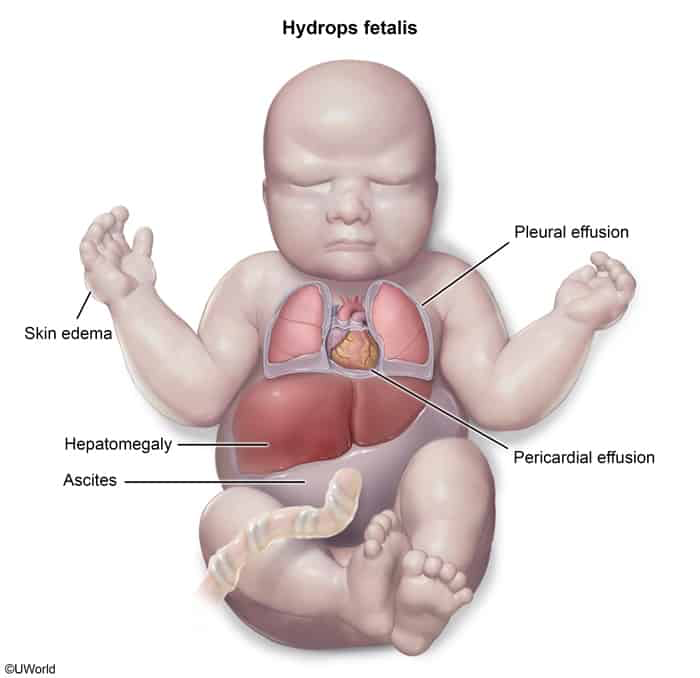
  • Definition: Excess fluid accumulation in ≥2 fetal body compartments. c
  • Fetal Ultrasound Findings:
    • Ascites, pleural effusion, pericardial effusion, scalp edema / generalized skin edema (>5 mm).
    • Polyhydramnios (impaired fetal swallowing/fluid clearance).
    • Placentomegaly (placental thickness >4 cm).
  • Fetal Heart Rate Tracing:
    • Sinusoidal FHR pattern (indicates severe, life-threatening fetal anemia).
  • Maternal Manifestations:
    • Mirror syndrome (Ballantyne syndrome): Maternal development of preeclampsia-like symptoms (generalized edema, HTN, proteinuria) mirroring fetal hydrops condition.

Diagnosis

  • Initial/Screening (Prenatal US):
    • Diagnostic confirmation by detecting fluid accumulation in ≥2 body cavities on US.
    • Middle Cerebral Artery Peak Systolic Velocity (MCA-PSV): Non-invasive Doppler screening for fetal anemia (MCA-PSV >1.5 MoM indicates severe anemia).
  • Maternal Diagnostic Workup:
    • ABO/Rh typing, Indirect Coombs test (antibody titer; ≥1:16 for anti-D is critical threshold).
    • Kleihauer-Betke (KB) test: Quantifies fetomaternal hemorrhage.
    • Maternal serologies: TORCH panel, Parvovirus B19 IgM/IgG/PCR.
  • Confirmatory / Gold Standard:
    • Percutaneous Umbilical Blood Sampling (PUBS / Cordocentesis): Direct sampling of fetal blood for Hb/Hct, blood group, Direct Coombs test, blood gas analysis. Enables immediate therapy.
    • Amniocentesis / CVS: Karyotype, chromosomal microarray, infection PCR.

Differential Diagnostics

  • Isolated Fetal Ascites / Pleural Effusion:
    • Fluid in only 1 fetal compartment; does not fulfill criteria for hydrops fetalis (requires ≥2).
  • Cystic Hygroma:
    • Localized nuchal lymphatic malformation (commonly 45,X); can progress to hydrops, but initial disease is limited to nuchal tissue.
  • Congenital Heart Failure w/o Hydrops:
    • Cardiomegaly and high cardiac output state on fetal echocardiogram w/o fluid extravasation into multiple body cavities.

Management

  • Immediate Stabilization & Etiology-Based Interventions:
    • Severe Fetal Anemia (Rh alloimmunization, Parvovirus B19):
      • Intrauterine Transfusion (IUT): Access umbilical vein via PUBS to deliver O-negative PRBCs if GA <34 weeks.
    • Fetal Arrhythmia (e.g., SVT):
      • Transplacental antiarrhythmic administration to mother (e.g., Digoxin, Flecainide, Sotalol).
  • Prevention (Rh Incompatibility):
    • Anti-D Immune Globulin (RhoGAM): Administered to nonsensitized Rh-negative mothers at 28 weeks GA and within 72 hrs post-delivery, miscarriages, or invasive procedures.
  • Timing & Mode of Delivery:
    • If GA ≥34 weeks or fetal pulmonary maturity confirmed: Immediate delivery.
    • Urgent C-section for Category III FHR tracing (e.g., sinusoidal FHR pattern) or severe fetal decompensation.
  • Postnatal Resuscitation:
    • Immediate endotracheal intubation.
    • Emergent thoracentesis and/or paracentesis to decompress cavities and allow lung expansion.

Complications

  • Fetal/Neonatal:
    • Pulmonary hypoplasia (compression from pleural effusion/ascites).
    • High cardiac output heart failure.
    • Intrauterine Fetal Demise (IUFT) or severe neonatal asphyxia (mortality >50%).
  • Maternal:
    • Mirror syndrome: Life-threatening maternal disease; requires treatment of fetal cause or prompt delivery.
    • Postpartum hemorrhage (secondary to severe uterine overdistension from polyhydramnios).