Clinical features
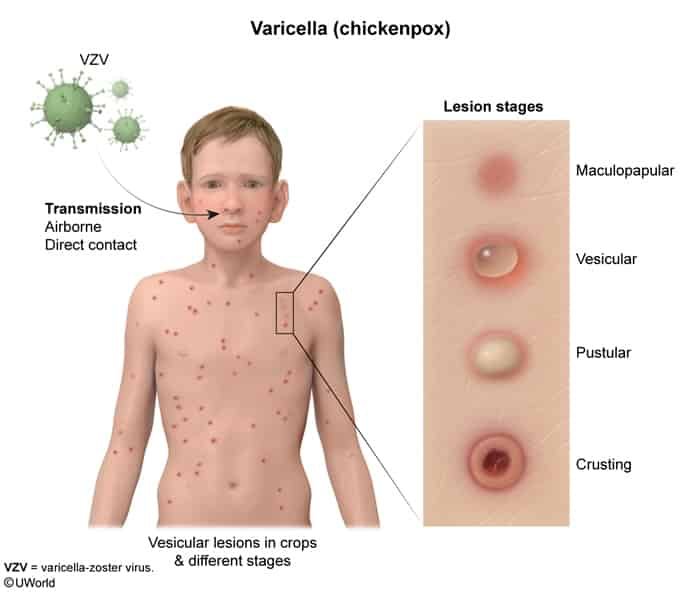
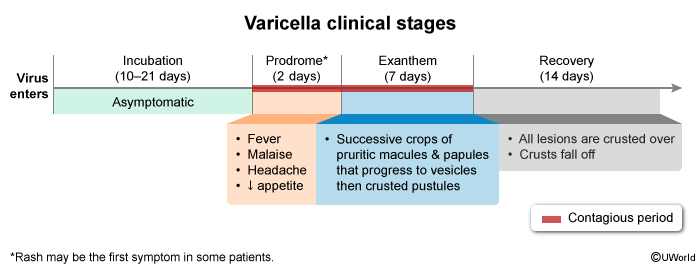
- Prodrome: Low-grade fever, malaise, pharyngitis (1–2 days prior to rash; more severe in adults/adolescents).
- Cutaneous findings:
- Pruritic macules evolving rapidly to papules, then fluid-filled vesicles on an erythematous base (“dewdrops on a rose petal”).
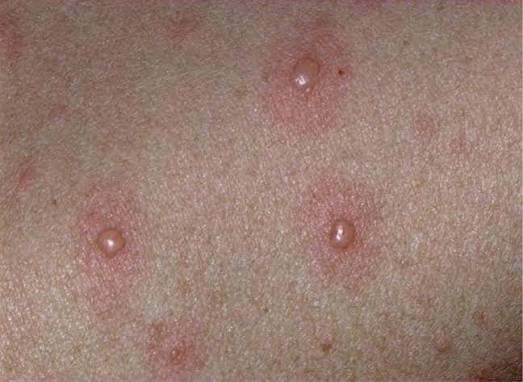

- Vesicular fluid becomes cloudy (pustules) -> ruptures -> crusts over.
- Pathognomonic: Lesions in multiple stages of development simultaneously (macules, papules, vesicles, crusts).
- Pruritic macules evolving rapidly to papules, then fluid-filled vesicles on an erythematous base (“dewdrops on a rose petal”).
- Distribution: Starts on trunk/face -> spreads centrifugally to extremities; mucosal involvement (e.g., painful oral ulcers) is common.
Subtypes and variants
Vaccine-associated chickenpox rash
- Etiology & Timing: Caused by live-attenuated Oka strain VZV vaccine; occurs 1–3 weeks post-vaccination in ~5% of patients.
- Clinical Features:
- Sparse rash: Usually < 10 lesions (maculopapular or small vesicles on an erythematous base).
- Distribution: Localized near injection site or mild generalized distribution.
- Systemic symptoms: Minimal to absent (no or low-grade fever).
- Diagnosis:
- Clinical: History of recent VZV vaccine (1–4 weeks) + mild, sparse vesicular rash.
- Confirmatory: VZV PCR (distinguishes Oka vaccine strain from wild-type); indicated only if severe/immunocompromised.
- Key Differentials:
- Wild-type Varicella: High fever, >200 lesions in various stages of development, exposure history.
- Breakthrough Varicella: Wild-type infection occurring > 42 days post-vaccination.
- Management:
- Immunocompetent: Supportive care only; cover lesions until fully crusted. No acyclovir needed.
- Immunocompromised / Disseminated: Systemic Acyclovir (oral/IV).
- Infection Control: Direct contact transmission possible; isolate from non-immune pregnant women, neonates, and immunocompromised individuals until crusted.
Diagnosis
- Initial/Primary: Clinical diagnosis based on characteristic rash in various stages and exposure history.
- Confirmatory/Gold Standard: VZV PCR of fluid scraped from base of active vesicles (rarely necessary c ; reserved for atypical or severe cases in immunocompromised).
- Key Labs:
- Tzanck smear: Shows multinucleated giant cells (historical, low specificity; cannot differentiate VZV from HSV).
- Serology: VZV IgM/IgG ELISA (used to confirm post-vaccination immunity or exposure status).
Management
- Isolation & Infection Control:
- Airborne + Contact precautions in hospital settings until all lesions are crusted.
- Supportive Care (Uncomplicated disease in healthy children <12 yo):
- Symptomatic relief: Antihistamines for pruritus, acetaminophen for fever.
- AVOID ASPIRIN due to severe risk of Reye syndrome.
- Antiviral Therapy (Oral Acyclovir or Valacyclovir):
- Indications: Age ≥13 yo, chronic cutaneous/pulmonary disease, long-term salicylate/steroid use, complicated secondary cases.
- Timing: Must initiate within 24 hours of rash onset to reduce severity/duration.
- IV Acyclovir:
- Indications: Immunocompromised pts, severe/complicated disease (e.g., varicella pneumonia, encephalitis), or pregnant women w/ systemic complications.
- Post-Exposure Prophylaxis (PEP):
- Immunocompetent & unvaccinated (≥1 yo): Varicella vaccine within 3–5 days of exposure. c
- High-risk/Vaccine contraindicated (immunocompromised, pregnant, neonates w/ maternal infection 5 days before to 2 days after delivery): Varicella-Zoster Immune Globulin (VARIZIG) within 10 days (ideally ≤96 hr). If VARIZIG unavailable -> IVIG or oral acyclovir.