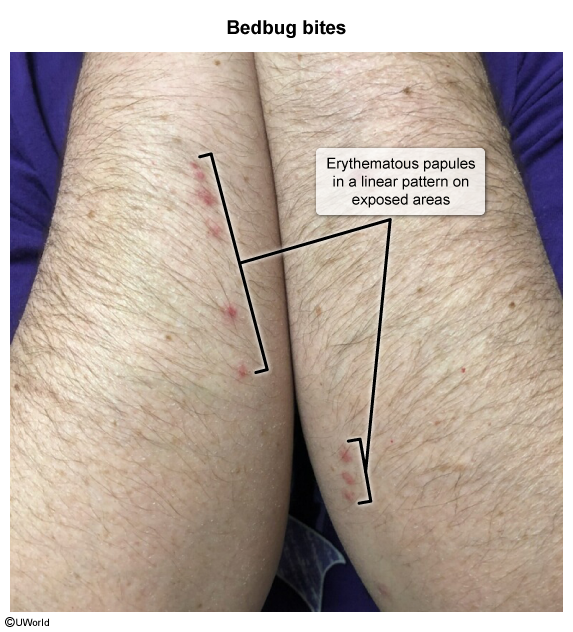
Not associated with poor individual hygiene or low socioeconomic status.
Clinical Features
History:
Painless nocturnal biting; lesions noticed upon waking.
Intense pruritus, often worsening over subsequent days due to sensitization.
Physical Exam:
Erythematous, pruritic macules, papules, or wheals (2–5 mm) with a central hemorrhagic punctum.
Classic pattern: “Breakfast, lunch, and dinner” configuration (linear or clustered array of 3–5 bites).
Distribution: Exposed areas during sleep (face, neck, arms, hands, lower legs).
Environmental clues: Dark rust-colored/black fecal spots or blood stains on bedsheets, mattress seams, or baseboards.
Diagnosis
Initial/Screening: Clinical suspicion based on lesion morphology, linear distribution, and exposure history.
Confirmatory/Gold Standard: Direct visualization and identification of the insect, nymphs, eggs, or shed exoskeletons in mattress seams, headboards, or crevices.
Key Labs/Biopsy:
Routine labs: Not indicated.
Skin biopsy: Rarely indicated; reveals nonspecific bite reaction (wedge-shaped superficial and deep perivascular infiltrate with prominent eosinophils and epidermal spongiosis).
Differential Diagnostics
Scabies (Sarcoptes scabiei):
Diff by predilection for web spaces of fingers, flexor wrists, axillae, genitalia; presence of burrows; severe nocturnal itch; confirmed via skin scrapings with mineral oil.
Flea bites (Ctenocephalides spp.):
Diff by localization predominantly around the lower legs and ankles; history of domestic pet exposure.
Acute Urticaria:
Diff by transient, migratory wheals that resolve within 24 hours without leaving central puncta; often triggered by foods, drugs, or viral infections.
Tick Bites:
Diff by solitary, larger, often non-pruritic attachment; possible vector for systemic illness (e.g., Lyme disease with erythema migrans).
Management
First-line (Symptomatic Relief):
Topical corticosteroids (e.g., triamcinolone 0.1% or OTC hydrocortisone) to reduce pruritus and inflammation.
Oral antihistamines (e.g., cetirizine, diphenhydramine, hydroxyzine) for symptomatic itch relief, especially at night.
Environmental Eradication (Definitive):
High-temperature laundering of bedding and clothing (>60°C / >140°F) and hot-cycle drying for ≥30 min.
Professional pest control (heat treatment of room to >50°C / >122°F, chemical insecticides such as pyrethroids or desiccants).
Vacuuming crevices and encasing mattresses with bug-proof covers.
Refractory / Complicated Cases:
Oral corticosteroids (short taper) for severe systemic hypersensitivity/bullous reactions.
Empiric oral Abx (e.g., cephalexin) if secondary bacterial infection is present.
Complications
Secondary bacterial superinfection (e.g., impetigo, cellulitis) due to excoriation (Staphylococcus aureus, Streptococcus pyogenes).
Post-inflammatory hyperpigmentation.
Insomnia, anxiety, and psychological distress (entomophobia, delusional parasitosis).