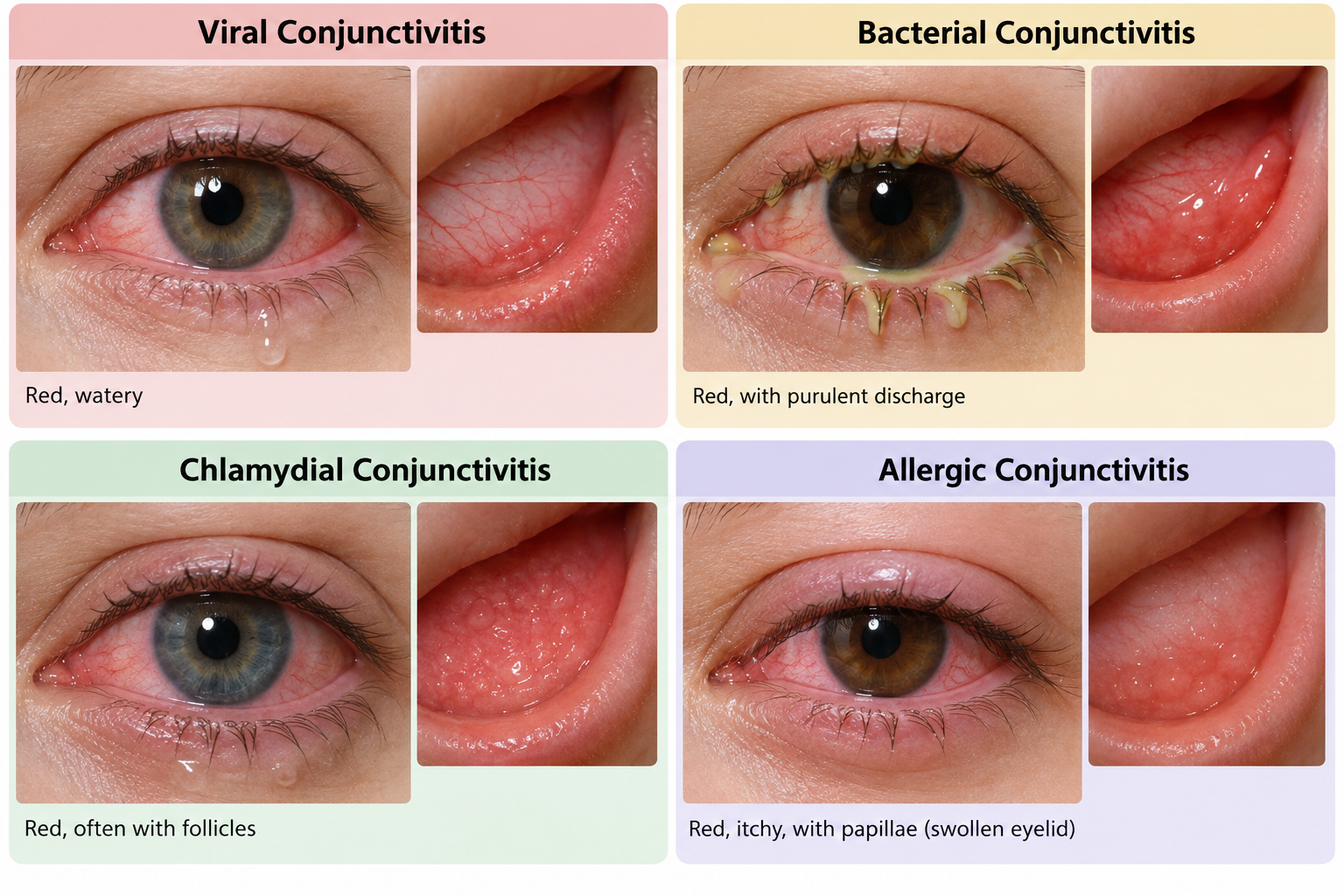
| Feature | Viral | Bacterial | Chlamydial | Allergic |
|---|
| Etiology | Adenovirus | S. aureus, S. pneumo, H. flu | C. trachomatis (D–K or A–C) | IgE-mediated / Allergens |
| Discharge | Watery / serous | Thick, copious purulent (crusted shut) | Mucopurulent / watery | Watery / stringy |
| Key Exam | (+) Preauricular LAD, follicles | Injection, no LAD | Tarsal follicles, subacute/chronic | Intense itching, cobblestone papillae, chemosis |
| Laterality | Unilateral → Bilateral | Unilateral or bilateral | Often unilateral | Strictly bilateral |
| First-Line Tx | Supportive (cold compresses) | Topical Abx (Erythromycin, Polymyxin/TMP) | Oral Azithromycin (systemic Tx required) | Topical Olopatadine or Ketotifen |
| High-Yield Pearl | Recent URI / swimming pool | Contact lens wearer → Topical FQ (Pseudomonas) | Neonate: Day 5–14 (give PO macrolide) | Pt has atopy/rhinitis |
 | | | | |
Epidemiology & Risk Factors
- Highly contagious; spread via direct contact/fomites.
- Most common pathogens (Adults): S. aureus. c
- Most common pathogens (Kids): S. pneumoniae, H. influenzae, M. catarrhalis.
- Contact lens wearers: Pseudomonas aeruginosa is highly prevalent and dangerous.
- Neonates: Vertical transmission of N. gonorrhoeae or C. trachomatis.
Clinical Features
- Thick, purulent discharge (yellow, green, or white) that continues throughout the day.
- Eyelids “stuck shut” in the morning (crusting/matting).
- Unilateral onset, but often spreads to the contralateral eye.
- Conjunctival injection/erythema and chemosis.
- Minimal to no itching (diff from allergic).
- No changes in visual acuity, pupillary reflex, or corneal clarity.
Diagnosis
- Initial: Clinical diagnosis based on history and physical exam (empiric Tx started immediately).
- Key Labs: Conjunctival swab for Gram stain, culture, and PCR.
- Indicated only for: contact lens wearers, neonates, suspected hyperacute gonococcal infection, or cases refractory to standard empiric Abx.
- Slit-lamp exam: Assesses for corneal involvement (fluorescein staining to rule out keratitis/corneal ulcer).
Differential Diagnostics
- Viral Conjunctivitis: Diff by watery/mucoid discharge, prominent preauricular lymphadenopathy, and viral prodrome (pharyngitis, fever).
- Allergic Conjunctivitis: Diff by bilateral intense pruritus (itching), watery discharge, and history of atopy.
- Chlamydial Conjunctivitis (Adult Inclusion Conjunctivitis): Diff by chronic course (>2–3 weeks) refractory to standard topical Abx, follicular tarsal conjunctivitis (cobblestone appearance of palpebral conjunctiva), nontender preauricular LN, and concurrent urogenital symptoms (urethritis/cervicitis).
- Keratitis: Diff by severe eye pain, photophobia, decreased visual acuity, and corneal opacity/ulcer on fluorescein stain.
- Neonatal Conjunctivitis: Diff by timing of onset:
- Chemical: < 24 hours post-birth (due to silver nitrate prophylaxis).
- Gonococcal: 2–5 days post-birth (marked eyelid swelling, profuse purulent discharge, risk of blindness).
- Chlamydial: 5–14 days post-birth (mild to moderate purulent discharge, associated with pneumonia).
Management
- Empiric Topical Abx (Non-Contact Lens Wearers):
- Erythromycin 0.5% ophthalmic ointment OR Polymyxin B/Trimethoprim drops.
- Contact Lens Wearers (Coverage for Pseudomonas):
- Topical Fluoroquinolones (e.g., Ciprofloxacin, Ofloxacin, Moxifloxacin).
- Crucial step: Immediately discontinue contact lens wear. Throw away current lenses & case.
- Hyperacute / Gonococcal Conjunctivitis:
- Systemic Abx: Ceftriaxone 1 g IM single dose + Azithromycin 1 g PO (to cover C. trachomatis).
- Frequent ocular saline irrigation.
- Chlamydial Conjunctivitis (Adults):
- Oral Azithromycin 1 g PO single dose OR Doxycycline 100 mg PO BID for 7 days.
- Neonatal Conjunctivitis:
- Prophylaxis (All Newborns): Topical Erythromycin 0.5% ointment within 1 hr of birth. c
- N. gonorrhoeae: Single dose IV/IM Ceftriaxone or Cefotaxime.
- C. trachomatis: Oral Erythromycin or Azithromycin (monitor for IHPS / infantile hypertrophic pyloric stenosis).
Complications
- Keratitis or corneal ulceration.
- Corneal perforation and permanent vision loss (especially with N. gonorrhoeae or Pseudomonas).
- Dacryocystitis or preseptal cellulitis.