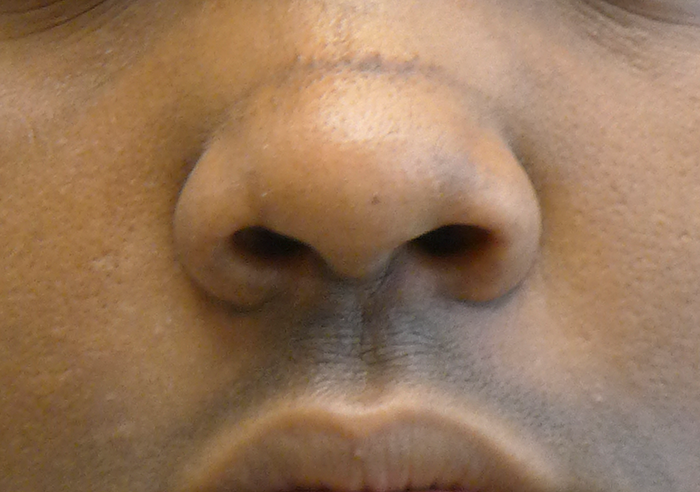
“Allergic shiners”: Infraorbital dark circles due to venous stasis.
“Allergic salute”: Transverse nasal crease across the bridge of the nose from chronic upward rubbing.
“Dennie-Morgan lines”: Accentuated skin folds beneath the lower eyelids.
“Cobblestoning”: Hyperplastic lymphoid follicles on the posterior pharyngeal wall from chronic postnasal drip.
Diagnosis
Initial/Screening: Clinical diagnosis based on characteristic hx and PE findings; routine testing is unnecessary.
Confirmatory/Gold Standard: Percutaneous skin-prick testing (detects specific allergen-induced IgE; reserved for refractory cases or when planning immunotherapy).
Key Labs:
Serum allergen-specific IgE (RAST/ImmunoCAP): Indicated if skin-prick testing is contraindicated (e.g., severe dermatographism, extensive eczema, inability to withdraw antihistamines).
Imaging: Not routinely indicated; non-contrast sinus CT only if chronic rhinosinusitis or anatomical obstruction (e.g., neoplasm, deviated septum) is suspected.
Biopsy: Not indicated.
Differential Diagnostics
Nonallergic (Vasomotor) Rhinitis:
Diff by later onset (>20 yo), predominance of nasal congestion/rhinorrhea without pruritus or sneezing, triggers include weather/temperature shifts, spicy foods, and irritants/odors; nasal mucosa typically erythematous rather than pale/boggy; (-) allergy testing.
Rhinitis Medicamentosa:
Diff by hx of topical nasal decongestant use (e.g., oxymetazoline, phenylephrine) for >3–5 consecutive days; marked rebound congestion upon withdrawal; beefy-red, swollen mucosa.
Infectious Rhinitis (Viral URI):
Diff by acute onset, transient course (<7–10 days), associated systemic features (malaise, low-grade fever, sore throat), and erythematous (not pale) nasal mucosa.
Nasal Polyposis:
Diff by direct visualization of smooth, gray, avascular, tear-shaped masses in the middle meatus; often associated with Aspirin-Exacerbated Respiratory Disease (AERD) or cystic fibrosis in pediatrics.
CSF Rhinorrhea:
Diff by clear, persistent, unilateral rhinorrhea that increases with leaning forward or Valsalva, presence of a metallic or salty taste, and positive test for beta-2 transferrin; often follows head trauma or skull base surgery.
Management
Environmental & General Measures:
Allergen avoidance (HEPA air filters, impermeable mattress/pillow encasings, pet exclusion).
Isotonic nasal saline irrigation (flushes allergens and thins secretions).
Preferred for mild or intermittent symptoms; poor efficacy for congestion.
Favored over 1st-generation antihistamines (diphenhydramine, chlorpheniramine) due to lack of sedation and anticholinergic effects.
Second-line / Combination Therapy:
Combination INCS + Intranasal Antihistamine (e.g., fluticasone + azelastine): Superior to monotherapy for severe symptoms refractory to single-agent INCS.
Intranasal antihistamines (e.g., azelastine, olopatadine): Rapid onset, effective for nasal congestion and postnasal drip.
Leukotriene receptor antagonists (LTRA) (e.g., montelukast): Useful adjunct in pts with concurrent asthma; black box warning for neuropsychiatric events.
Intranasal cromolyn: Mast cell stabilizer; safe in pregnancy and pediatrics, but requires frequent dosing (tid–qid) and pre-exposure administration.
Oral/Topical Decongestants (e.g., pseudoephedrine, oxymetazoline): Limit topical use to <3–5 days to prevent rebound congestion (rhinitis medicamentosa).
Refractory Disease:
Allergen-specific Immunotherapy (AIT):
Subcutaneous (SCIT) or sublingual (SLIT).
Only disease-modifying treatment; reduces risk of future asthma development; indicated for severe symptoms refractory to pharmacotherapy or intolerable medication side effects.
Complications
Secondary bacterial rhinosinusitis (due to ostiomeatal complex obstruction).
Otitis media with effusion (OME) and Eustachian tube dysfunction.
Exacerbation of comorbid asthma.
Chronic mouth breathing leading to craniofacial abnormalities (e.g., high-arched palate, dental malocclusion) in children.
Obstructive sleep apnea (OSA), sleep fragmentation, and daytime somnolence.
Rhinitis medicamentosa secondary to improper over-the-counter decongestant use.