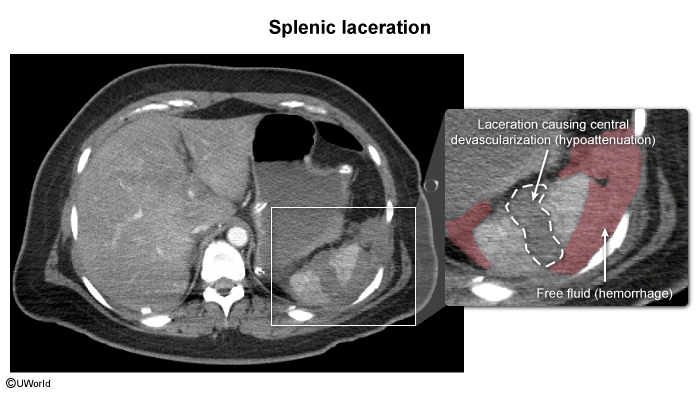
Anatomical risk: Splenomegaly from any etiology renders the spleen highly susceptible to trauma.
Clinical Features
History of blunt abdominal trauma or recent viral illness/fever.
LUQ abdominal pain.
Left shoulder pain (Kehr sign) due to blood/phrenic nerve irritation of the diaphragm.
Peritoneal signs (guarding, rigidity, rebound tenderness) if hemoperitoneum is present.
Hemodynamic instability / Hypovolemic shock:
Hypotension (BP < 90 mmHg).
Tachycardia (HR > 120 bpm).
Cold, clammy skin, diaphoresis.
Altered mental status.
Diagnosis
Initial/Screening:
Hemodynamically unstable patient: FAST (Focused Assessment with Sonography for Trauma) scan to look for free fluid (hemoperitoneum) in the RUQ, LUQ, pelvis, and pericardium.
Hemodynamically stable patient: Contrast-enhanced CT scan of the abdomen/pelvis (highly sensitive and specific; evaluates degree of injury and checks for contrast extravasation/“blush”).
Confirmatory/Gold Standard: Contrast-enhanced CT scan of the abdomen/pelvis (grades splenic injury from I to V).
Key Labs:
Serial Hgb/Hct (Note: May be normal initially in acute hemorrhage).
Type & Crossmatch (for immediate transfusion if needed).
Hemodynamically Unstable Patient (with positive FAST or peritoneal signs):
Urgent exploratory laparotomy.
Splenectomy is standard in unstable patients to control life-threatening hemorrhage (partial splenectomy or splenorrhaphy preferred in children if stable enough).
Hemodynamically Stable Patient (or stabilized after initial fluid bolus):
Nonoperative Management (NOM) is the standard of care, regardless of injury grade (I–V), if stable:
Strict bed rest, intensive monitoring (ICU), serial abdominal exams, and serial Hgb monitoring.
Splenic artery embolization (SAE) / Angioembolization if CT shows contrast blush (extravasation) or if AAST grade is IV-V.
Failure of NOM (e.g., drop in Hgb, worsening tachycardia/hypotension, development of peritonitis) requires conversion to laparotomy.
Post-Splenectomy Care (Prophylaxis):
Patients undergoing splenectomy require vaccinations against encapsulated organisms:
Streptococcus pneumoniae
Neisseria meningitidis
Haemophilus influenzae type b (Hib)
Timing: Administer vaccinations ≥ 14 days postoperatively (to maximize immune response), or 14 days preoperatively for elective procedures.
Daily prophylactic oral penicillin (especially in children) and education to seek immediate care and empiric broad-spectrum antibiotics (e.g., amoxicillin-clavulanate) for any fever.
Complications
Overwhelming Post-Splenectomy Infection (OPSI): Life-threatening fulminant sepsis, primarily caused by S. pneumoniae. Risk is highest in children and in the first few years post-splenectomy.
Delayed Splenic Rupture: Hemorrhage occurring days to weeks after blunt trauma (often due to subcapsular hematoma expansion and rupture).
Reactive Thrombocytosis: Transient, benign increase in platelet count (peaks 1–2 weeks post-op); usually does not require treatment unless severe or risk factors for thrombosis exist.
Pancreatic Fistula / Tail Injury: Iatrogenic injury during splenectomy due to the close proximity of the pancreatic tail to the splenic hilum.
Left Pleural Effusion / Atelectasis: Postoperative reactive effusion or diaphragmatic splinting due to pain.