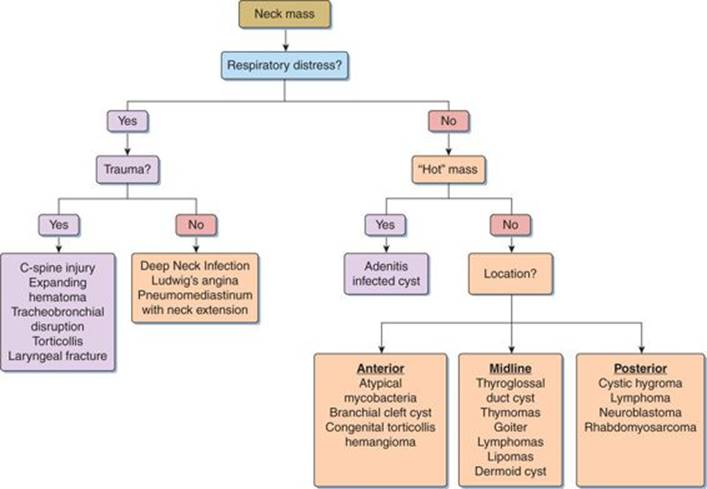
| Mass | Location | Pathophysiology | Key Differentiator |
|---|---|---|---|
| Thyroglossal Duct Cyst | Midline | Persistent thyroglossal duct remnant | Moves with swallowing |
| Branchial Cleft Cyst | Lateral (Ant. to SCM) | Incomplete obliteration of 2nd branchial cleft | Immobile with swallowing |
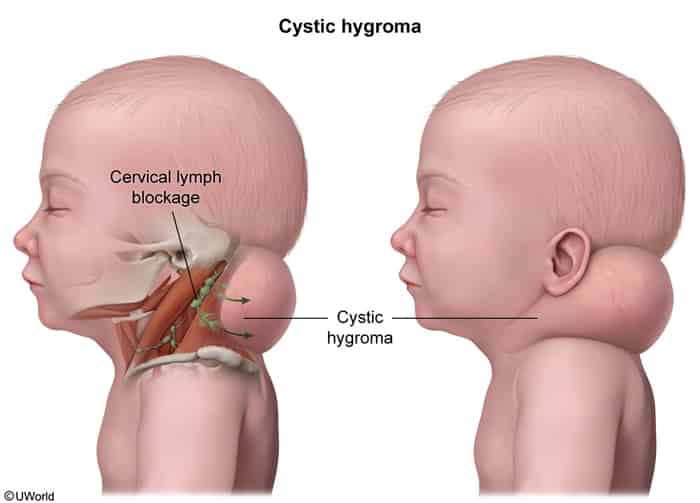
| Cystic Hygroma | Posterior Triangle | Malformation of lymphatic system | Transilluminates; Assoc. w/ Turner Syn. |
| Fibromatosis Colli | Within SCM muscle | Fibrous hyperplasia of SCM | Infantile Torticollis |
Thyroglossal duct cyst
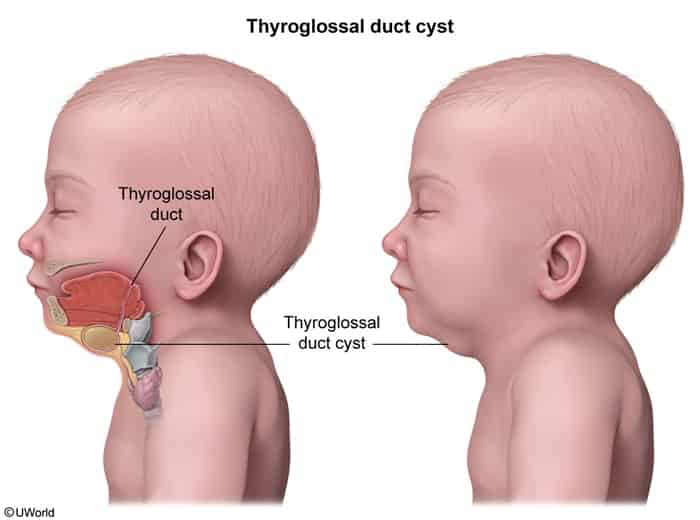
- Painless, firm, midline neck mass that elevates with swallowing and tongue protrusion
- Usually located near the hyoid bone
- May cause dysphagia or neck/throat pain
- Pathophysiology
- The thyroid gland originates from the foramen cecum at the base of the tongue and descends caudally into the neck, forming the thyroglossal duct.
- If the thyroglossal duct fails to obliterate, midline neck cysts or ectopic thyroid tissue can develop anywhere along its path.
Branchial cleft cyst
-
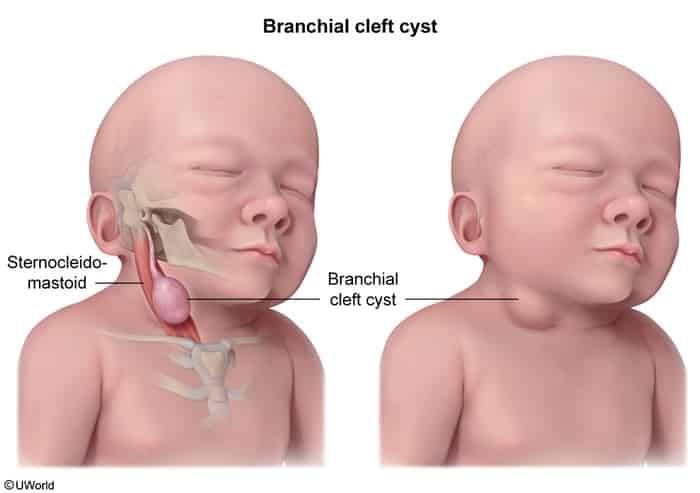
Definition: remnants of the embryological second branchial cleft or cervical sinus, which normally regresses before birth
-
Pathophysiology: formed due to incomplete obliteration of branchial clefts and pouches
-
Peak presentation: Late childhood, adolescence, or early adulthood (often unnoticed until rapid enlargement following an upper respiratory infection [URI]). c
-
Clinical features:
- Location: Lateral neck, characteristically along the anterior border of the sternocleidomastoid (SCM) muscle (near the angle of the mandible).
- Presentation:
- Painless, smooth, fluctuant, slow-growing lateral mass.
- Does NOT move with swallowing or tongue protrusion (crucial negative finding).
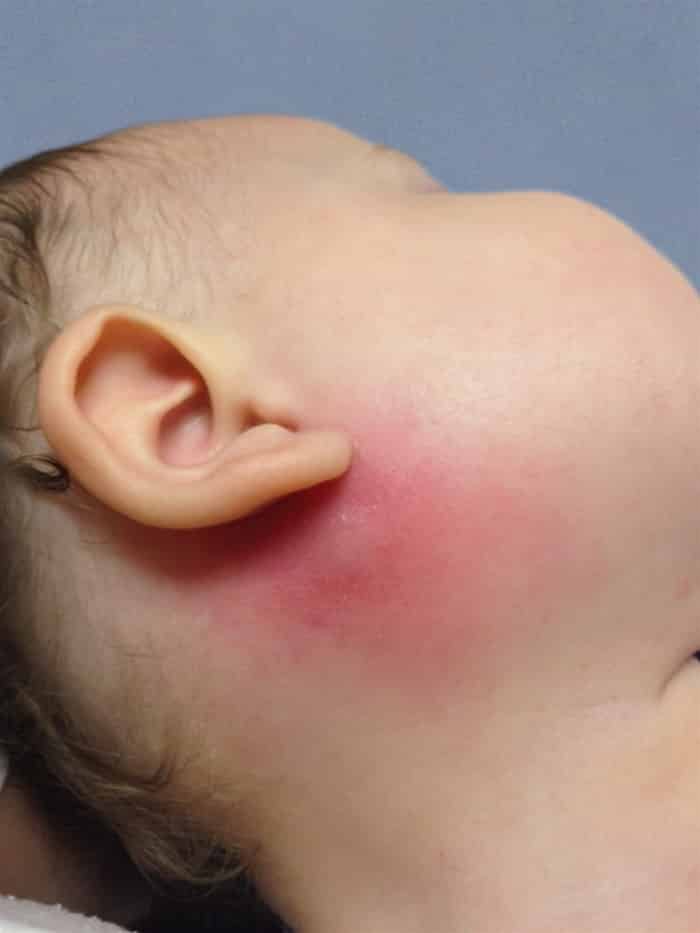
- May present as a tender, enlarged, erythematous mass if secondarily infected.
- External cutaneous opening or draining fistula/sinus tract may be present.

-
Ultrasound: Round mass with uniform low echogenicity and no internal septations
Tip
Branchial cleft cysts manifest as a painless, firm neck mass lateral to the midline.
Cystic hygroma
- Definition: a congenital lymphatic cyst (macrocystic lymphangioma) in the posterior triangle of the neck caused by malformation and obstruction of the fetal lymphatic system
- Epidemiology
- Strong association with Chromosomal Aneuploidies (detected in ~50% of cases).
- Turner Syndrome (45,XO): Most classic USMLE association.
- Trisomy 21 (Down Syndrome), Trisomy 18 (Edwards), Trisomy 13 (Patau).
- Clinical features
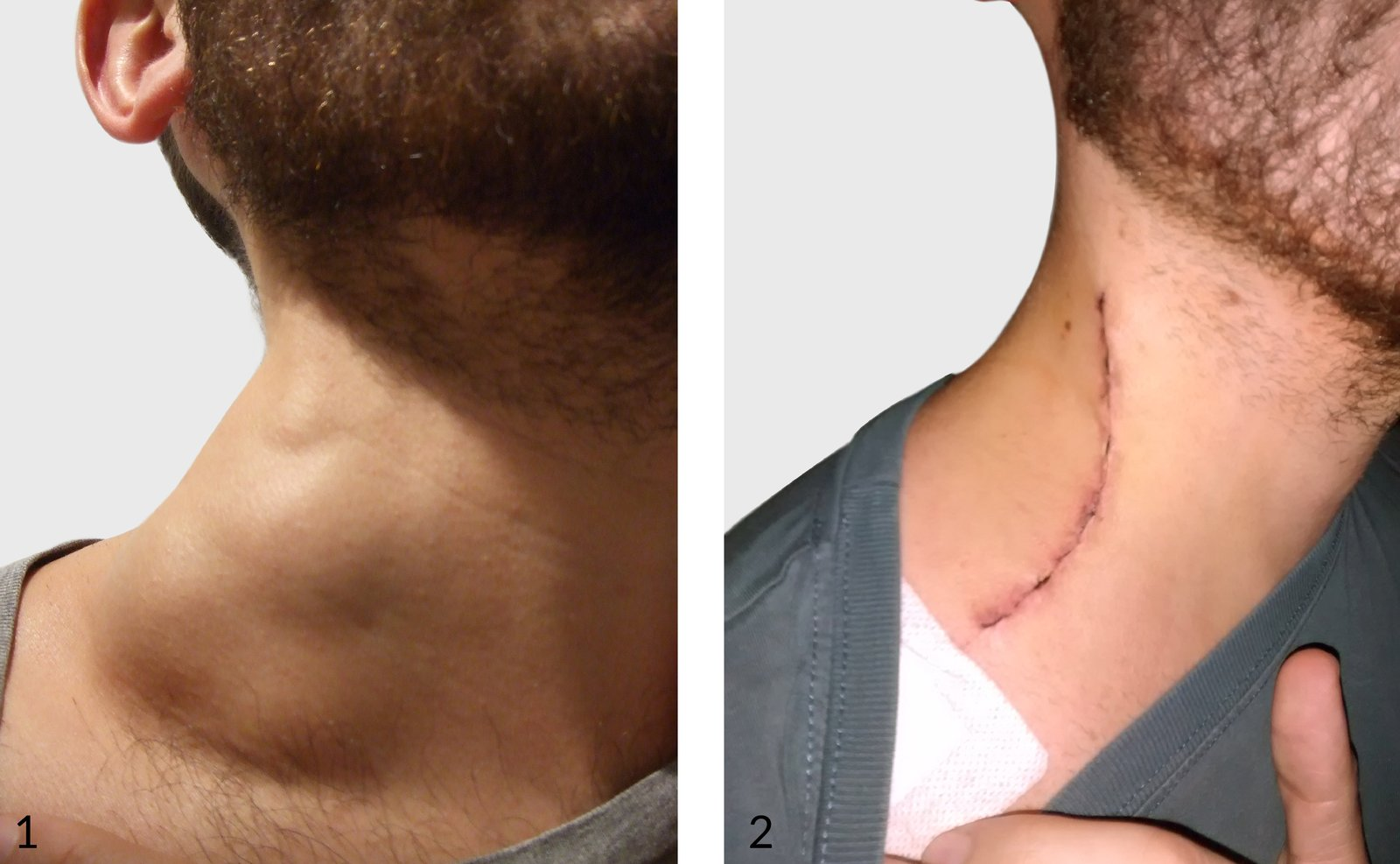
- Present at birth as a soft, compressible, painless, posterior triangle neck mass
- Can cause dysphagia or airway compromise
- Positive transillumination test
- Present at birth as a soft, compressible, painless, posterior triangle neck mass