Paresthesias: typically tingling or pins-and-needles sensation in extremities and/or in the perioral area
Spasms (e.g., carpopedal spasm, bronchospasm or laryngospasm), and cramps (possible in any muscle)
Stiffness, myalgia
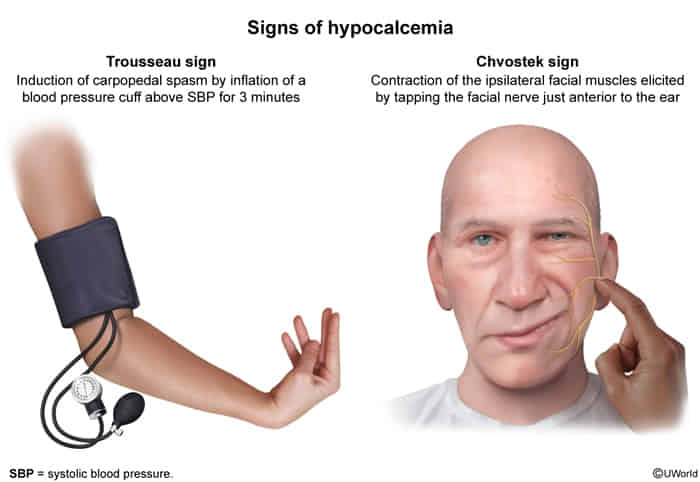
Maneuvers to elicit latent tetany on physical exam
Chvostek sign: short contractions (twitching) of the facial muscles elicited by tapping the facial nerve below and in front of the ear (∼ 2 cm ventral to the ear lobe)
Trousseau sign: ipsilateral carpopedal spasm occurring several minutes after inflation of a blood pressure cuff to pressures above the systolic blood pressure
Seizure: may be the initial or only symptom
Diagnostics
Initial/Screening: Serum ionized calcium (physiologically active form) or Corrected total calcium for hypoalbuminemia.
Formula: Corrected Ca = measured Ca + 0.8 * (4.0 - albumin). c
If serum albumin drops (e.g., NS, cirrhosis, malnutrition), the protein-bound fraction of Ca2+ decreases, which drops the measured total serum Ca2+.
Biochemical studies demonstrate that for every 1.0 g/dL drop in serum albumin below the normal baseline, the total serum Ca2+ concentration decreases by approximately 0.8 mg/dL.
4.0 g/dL is used as the standard reference value for “normal” serum albumin.