Reticulocyte count: Low / inappropriately suppressed for the degree of anemia (due to low EPO levels).
Peripheral Blood Smear (PBS): Normocytic, normochromic RBCs; no schistocytes, spherocytes, or sickled cells.
Direct Antiglobulin Test (DAT/Coombs): Negative.
Total & Direct Bilirubin: Normal (rules out active hemolysis).
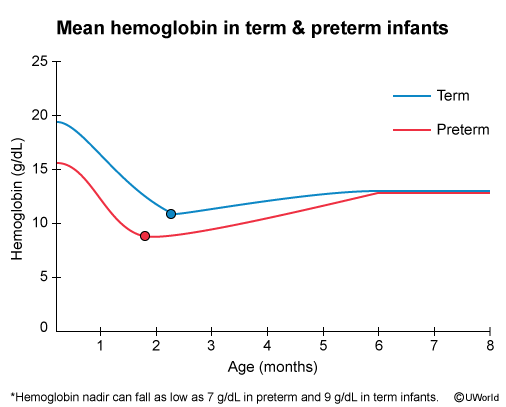
Confirmatory/Gold Standard: Clinical diagnosis of exclusion; confirms spontaneously as Hb rises after 8–12 weeks of life.
Differential Diagnostics
Anemia of Prematurity:
Diff by preterm birth (<37 wks), earlier/deeper nadir (Hb 7–9 g/dL at 4–8 wks), often symptomatic (apnea, bradycardia, poor feeding).
Hemolytic Disease of the Newborn (ABO/Rh Incompatibility):
Diff by presentation in first 24–48 hours of life, ↑ indirect bilirubin (jaundice), (+) DAT/Coombs, and ↑ reticulocytes.
Iron Deficiency Anemia (IDA):
Diff by onset >6 months in term infants (neonatal iron stores last 4–6 months), microcytic hypochromic (↓ MCV), ↑ RDW, ↓ ferritin.
Diamond-Blackfan Anemia:
Diff by severe macrocytic/normocytic anemia in early infancy, reticulocytopenia, and congenital anomalies (triphalangeal thumbs, cleft palate, short stature, webbed neck).
Perinatal Blood Loss (e.g., Feto-maternal hemorrhage, vasa previa, subgaleal hemorrhage):
Diff by acute presentation at birth (pallor, shock) or early days; ↑ reticulocyte response within days.
Management
First-line: Reassurance and Observation.
No treatment or diagnostic workup required in asymptomatic term infants.
Normal feeding patterns should continue.
Iron Supplementation:
Not indicated for treating physiologic anemia (iron stores are adequate; iron does not stimulate EPO).
Routine nutritional iron supplementation: Begin at 4 months of age (1 mg/kg/day) for exclusively breastfed term infants until iron-rich solids are introduced.
Transfusion:
Contraindicated/Not indicated for physiologic anemia.
Complications
Iatrogenic: Unnecessary testing or inappropriate blood transfusions due to misinterpretation of normal physiologic parameters.
Prognosis: Excellent; resolves spontaneously by 3–6 months of age as tissue oxygen demand rises and endogenous renal EPO production resumes.