Etiology
- Children: Peak age 2–5 yo; often preceded by viral illness or live-attenuated vaccine (e.g., MMR). Usually acute and self-limiting (spontaneous resolution within 6 months). c
- Adults: Peak age 20–40 yo; female predominance (F > M). Often insidious onset and chronic (> 12 months).
- Secondary ITP associations:
- Autoimmune: SLE, antiphospholipid syndrome.
- Infectious: HIV, HCV, H. pylori.
- Malignancy: CLL, lymphoma.
Pathophysiology
Antiplatelet antibodies (mostly IgG directed against, e.g., GpIIb/IIIa, GpIb/IX) bind to surface proteins on platelets → sequestration by spleen and liver → ↓ platelet count → bone marrow megakaryocytes and platelet production increase in response (in most cases).
Clinical features
- Mostly asymptomatic. Splenomegaly is very unusual in ITP and makes other diagnoses more likely!
- Although platelets can undergo splenic sequestration in ITP, the primary mechanism responsible for the thrombocytopenia is immune destruction.
Diagnostics
- Initial Test: CBC w/ Peripheral Blood Smear
- Isolated thrombocytopenia (Plt often < 20,000–30,000/L).
- Normal Hb/Hct (unless secondary to heavy bleeding) and normal WBC count.
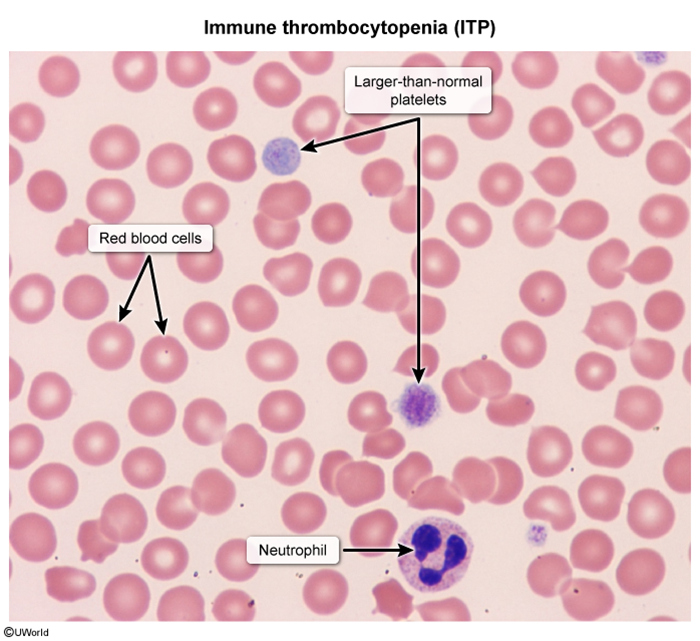
- Smear: Megathrombocytes (large platelets); absence of schistocytes, blasts, or platelet clumping.
- Secondary Workup (Mandatory in all pts):
- HIV and HCV testing (essential routine screening in all newly diagnosed adults).
- Direct antiglobulin test (DAT/Coombs) if concurrent anemia (to rule out Evans syndrome).
- ANA testing if features suggestive of SLE. c
- Confirmatory / Gold Standard:
- Diagnosis of exclusion; no specific confirmatory laboratory test exists (anti-platelet Ab testing has poor sensitivity/specificity and is not recommended).
- Bone Marrow Biopsy:
- Not routinely indicated.
- Indicated only if: Atypical features (age > 60 yo, systemic symptoms, other cytopenias) or failure to respond to standard therapy.
- Findings: Increased megakaryocytes with normal erythroid and myeloid precursors.
Differential diagnostics
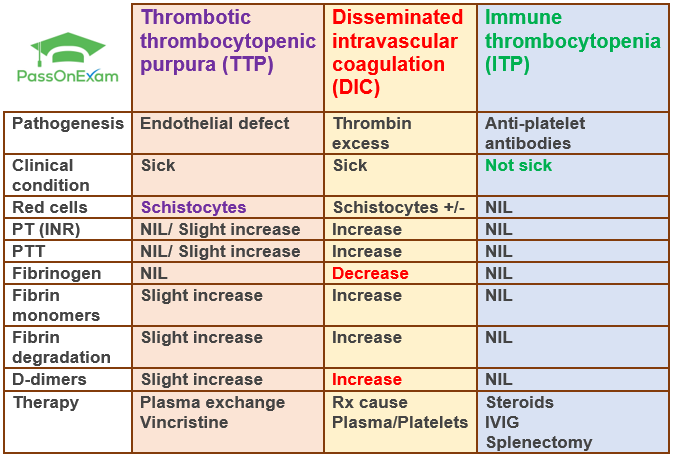
| Feature | Thrombotic Thrombocytopenic Purpura (TTP) | Immune Thrombocytopenia (ITP) |
|---|---|---|
| Patho | ↓ ADAMTS13 activity → Large vWF multimers → microvascular platelet thrombi | Anti-platelet (anti-GpIIb/IIIa) Abs → splenic destruction of platelets |
| Presentation | Pentad (FAT RN): Fever, Anemia (MAHA), Thrombocytopenia, Renal failure, Neurologic sx (e.g., confusion, stroke). Often acutely ill. | Isolated mucocutaneous bleeding (petechiae, purpura, epistaxis). Often asymptomatic. No splenomegaly. |
| Labs | MAHA triad: Anemia, Thrombocytopenia, Schistocytes on smear. ↑LDH, ↑Bilirubin, ↓Haptoglobin. Normal PT/PTT. Dx confirmed by ADAMTS13 assay (<10%). | Isolated thrombocytopenia (<100,000/µL). Smear may show megathrombocytes. Otherwise normal CBC & smear. Normal PT/PTT. Dx of exclusion. |
| Tx | EMERGENT. Plasma exchange (PEX) is first-line & life-saving. Corticosteroids, Rituximab. Platelet transfusion is CONTRAINDICATED (fuels thrombosis). | 1st line: Corticosteroids, IVIG. 2nd line: Splenectomy, Rituximab, TPO-RAs (e.g., romiplostim). Observe if plt >30k & no bleeding. |
Management
- Children:
- Skin-only bleeding (regardless of Plt count): Observation only (80% resolve spontaneously). c
- Active mucosal bleeding: Corticosteroids OR IVIG.
- Adults:
- Plt 30,000/L & asymptomatic: Observation.
- Plt < 30,000/L OR significant bleeding:
- First-line: Corticosteroids (Dexamethasone or Prednisone).
- Adjunct/Rapid rise: Add IVIG or Anti-D.
- Life-threatening bleeding (e.g., ICH): Platelet transfusion + IV Methylprednisolone + IVIG.
- Refractory / Chronic:
- TPO receptor agonists (Eltrombopag, Romiplostim).
- Rituximab (anti-CD20).
- Splenectomy (vaccinate 14 d prior). c