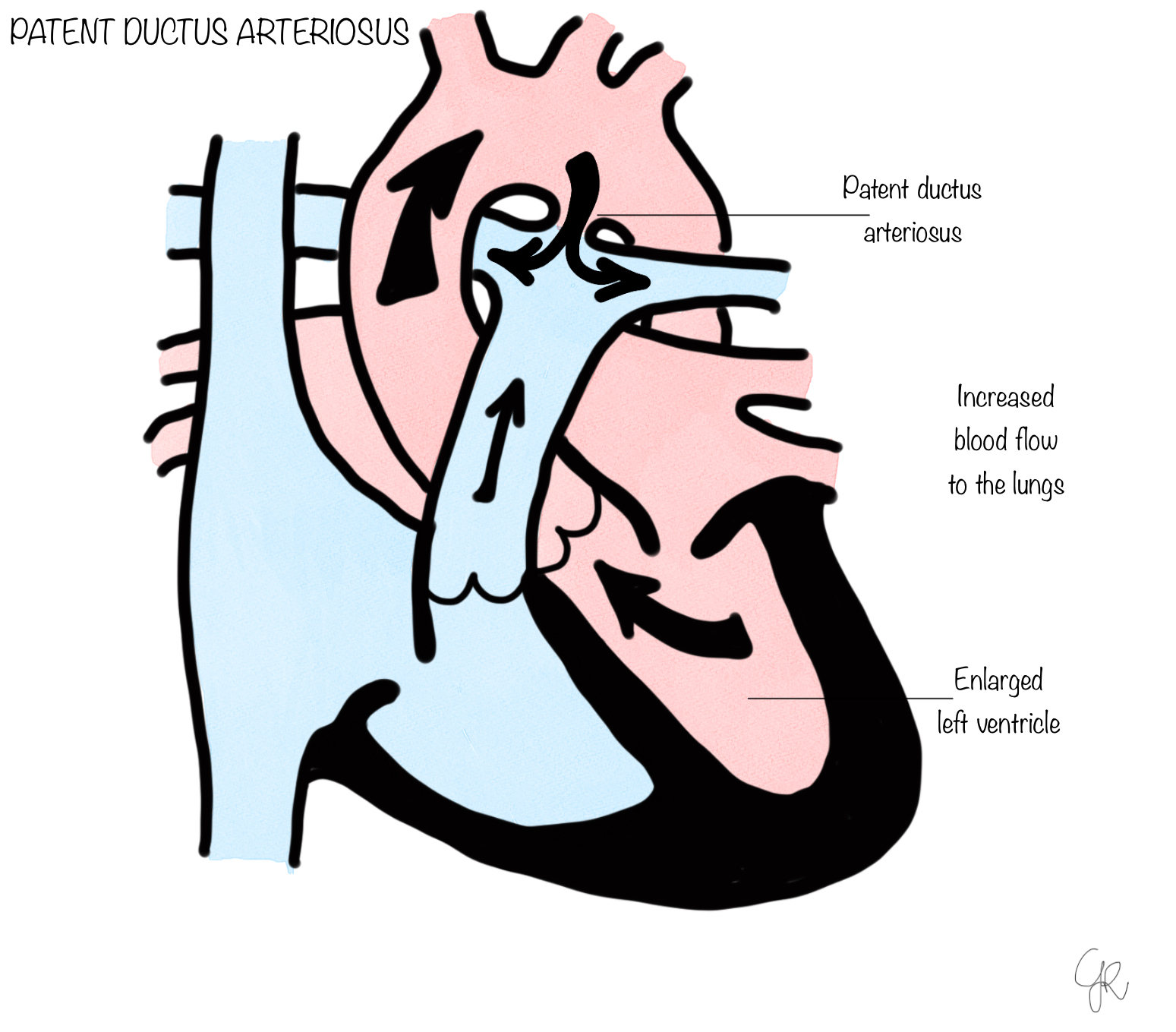
- Clinical Presentation
- Presentation depends on the size of the shunt. Small PDAs may be asymptomatic.
- Continuous, “machine-like” murmur loudest in the left infraclavicular region.
- As pulmonary hypertension develops (Eisenmenger syndrome), the characteristic machinery murmur decreases and ultimately disappears. This phenomenon is due to shunt reversal, which develops as soon as the pulmonary pressure exceeds the aortic pressure, thus decreasing blood flow through the PDA. A faint, short systolic murmur may briefly remain but is often absent.
- Bounding peripheral pulses and a widened pulse pressure t
- Blood “escapes” through the ductus during diastole (diastolic runoff), when aorta contracts.
- Similar to aortic regurgitation
- Differential Cyanosis (if Eisenmenger develops): Cyanosis of lower extremities; upper extremities (supplied by vessels proximal to PDA) remain pink.
- In large PDAs, signs of heart failure can develop, such as tachypnea, poor feeding, and failure to thrive.