Developmental milestones
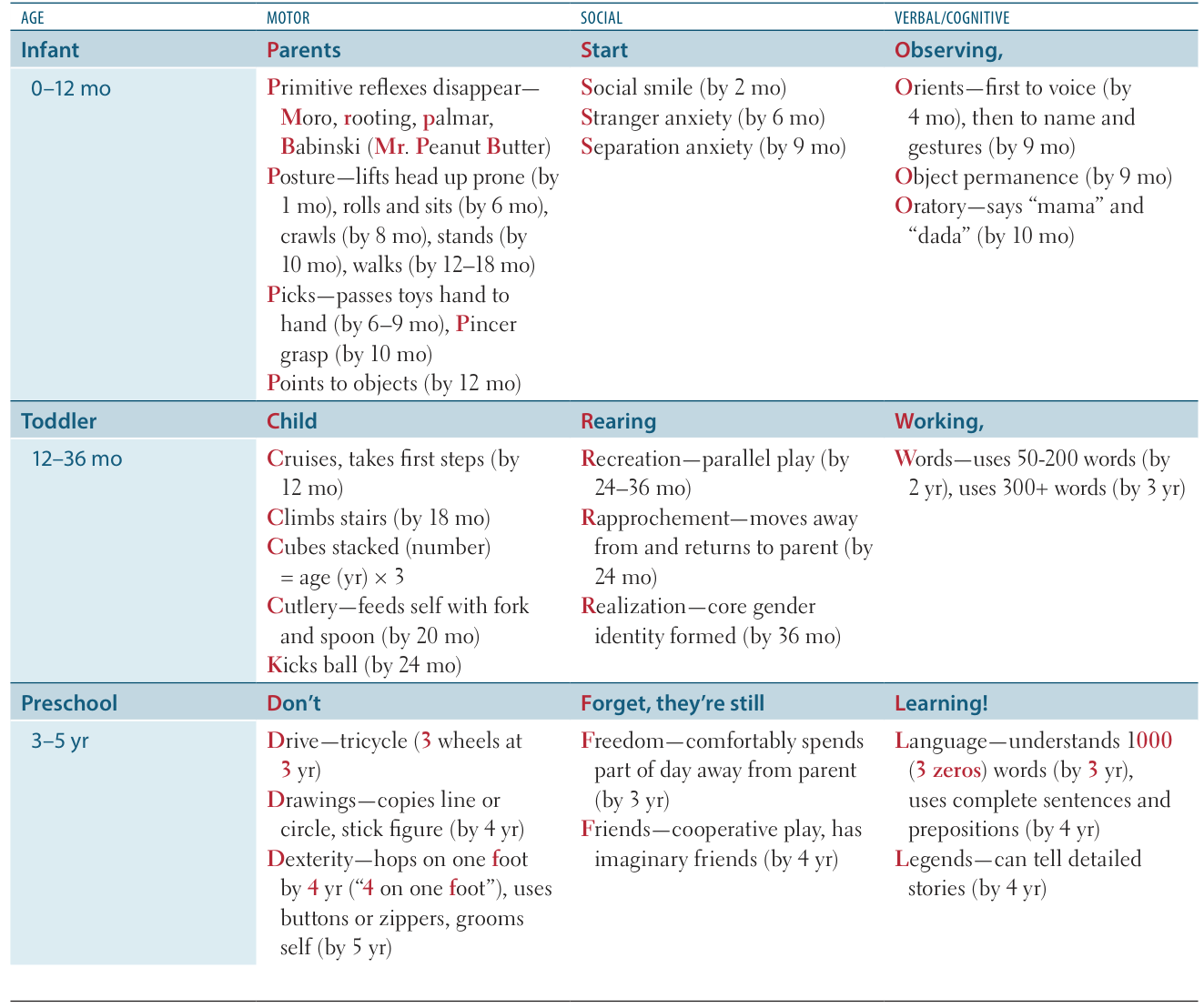
| Age | Gross Motor | Fine Motor | Language | Social/Cognitive |
|---|
| 1 year | Pulls to stand, Cruises | Pincer grasp | Says “mama” or “dada”, Understands “no” | Plays “pat-a-cake”, Looks for hidden object |
| 15 months | Takes a few steps | Stacks 2 blocks | Says 1 or 2 words (plus “mama” & “dada”) | Follows 1-step command with gesture, Points to get something, Shows affection |
| 18 months | Walks easily, Climbs on/off chair | Scribbles, Feeds with fingers | Says ≥3 words (plus “mama” & “dada”) | Follows 1-step command without gesture, Imitates |
| 2 years | Runs, Kicks ball, Walks up stairs | Uses spoon | Says 2-word phrases, Knows 2 body parts | Parallel play |
| 30 months | Jumps, Removes clothes | Turns pages | Says ≥50 words | Follows 2-step command, Knows 1 color |
| 3 years | Walks up stairs alternating feet, Rides tricycle | Dresses with help, Uses fork | Copies circle, Says ≥3-word sentences, Speech 75% intelligible | Knows age/sex, Plays with other children |
Common developmental behaviors
- Attachment: deep emotional bond that develops between an infant and their primary caregiver.
- Occurring at the expected age of 2 months
- Stranger anxiety: when an infant is fearful of unknown individuals
- Expected ages: 6 months–3 years
- Clinical features: crying and/or clinging to a known caregiver when around strangers
- Separation anxiety: when an infant or young child is afraid of being separated from their caregiver
- Expected ages: peaks between 9 and 18 months and resolves by 3 years of age
- Clinical features
- Crying and/or clinging to a caregiver if the caregiver tries to leave
- Continued crying after a caregiver has left
Vitals in children
- Higher HR: Kids need more CO per kg (higher metabolic/O₂ demand) but can’t increase SV much → CO maintained by ↑HR.
- Higher RR: Small lungs → limited VT; to meet ventilation needs → minute ventilation via ↑RR.
- Lower BP: Smaller SV + lower SVR/more compliant vessels → lower normal BP; they preserve BP until late via vasoconstriction. c2
Method
- Confirm the age (infant vs toddler vs school-age vs adolescent).
- Check SBP first (danger screen):
- <1 mo: SBP should be ≥60
- 1–12 mo: SBP should be ≥70 c
- 1–10 yr: SBP should be ≥ 70 + 2×age (yr)
- >10 yr: SBP should be ≥90 If below → hypotension = late shock (abnormal until proven otherwise).
- Use 3 broad “RR/HR” buckets (fast + good enough for exams):
- RR upper limit
- <1 yr: ~60
- 1–5 yr: ~40
- >5 yr: ~30
- HR resting “typical” ranges
- <1 yr: 100–160
- 1–2 yr: 90–150
- 2–5 yr: 80–140
- 6–12 yr: 70–120
- ≥13 yr: 60–100