Mnemonic
- Precision (reliability)
- Accuracy (validity)
- Precision (Reliability)
- Definition: The consistency and reproducibility of a test or measurement.
- Key Concept: If you repeat the measurement multiple times, do you get similar results?
- Error Type: Affected by Random Error.
- Relation to Sample Size: ↑ Sample size = ↓ Random error = ↑ Precision.
- Statistical Marker: Tighter (narrower) Confidence Interval indicates higher precision.
- Buzzword: “Consistency.”
- Validity (Accuracy)
- Definition: The trueness of test measurements; how close the measurement is to the actual (true) value or “gold standard.”
- Key Concept: Does the test measure what it is supposed to measure?
- Error Type: Affected by Systematic Error (Bias).
- Relation to Sample Size: ↑ Sample size does NOT increase validity (it only makes the result more precise around the biased value).
- Buzzword: “Trueness.”
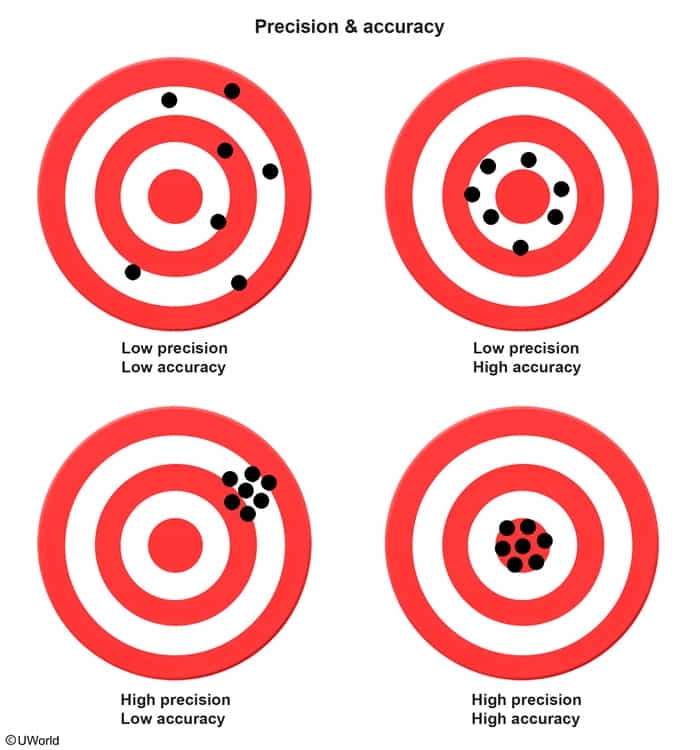
- The Target Analogy (Classic USMLE Visualization)
- High Precision, Low Validity: All shots hit the same spot, but far from the bullseye (consistent but wrong).
- High Validity, Low Precision: Shots are scattered all over, but the average is the bullseye (inconsistent, but average is correct).
- High Precision, High Validity: All shots hit the bullseye (consistent and correct).
- Types of Validity
- Internal Validity:
- Are the results valid for the specific population studied?
- Threatened by: Confounding, selection bias, measurement error.
- External Validity (Generalizability): t
- Can the results be applied to the general population or other settings?
- Threatened by: overly strict inclusion/exclusion criteria (e.g., a study only on 25-year-old males cannot be generalized to elderly females).
- Internal Validity: