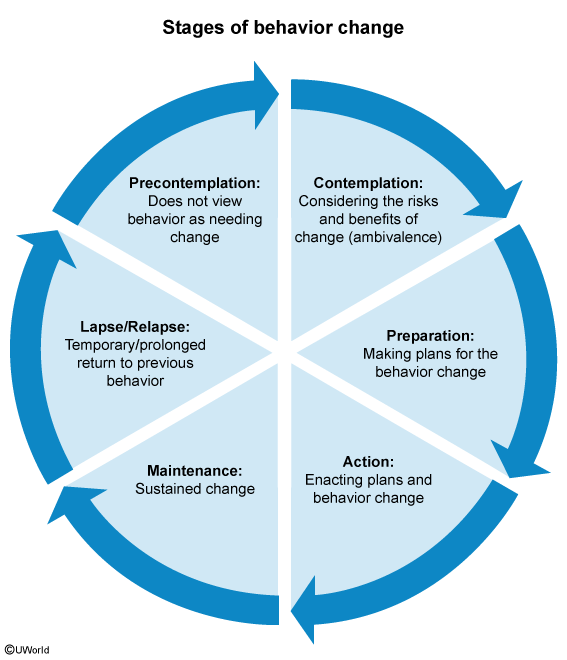
 Defense mechanisms are often used in the precontemplation or contemplation phases to avoid acknowledging the problem or making behavioral changes.
- Stages of Change
- Precontemplation
- Description: Patient does not recognize the problem and has no intention of changing behavior in the near future (< 6 months).
- Key Feature: Denial or ignorance of the consequences. “I don’t have a problem.”
- Contemplation
- Description: Patient acknowledges the problem and is considering change within the next 6 months but is ambivalent t .
- Key Feature: Weighing pros and cons. “I know smoking is bad, but it relaxes me.”
- Preparation
- Description: Patient intends to take action in the immediate future (< 1 month) and has taken some small steps toward behavior change.
- Key Feature: Making plans (e.g., buying nicotine patches, signing up for a gym).
- Action
- Description: Patient has actively modified the behavior.
- Key Feature: Overt lifestyle changes have occurred but have lasted < 6 months.
- Maintenance
- Description: Patient has sustained the behavior change for > 6 months.
- Key Feature: Focus shifts to preventing relapse.
- Relapse
- Description: Return to previous problem behavior.
- Key Feature: Accepted as a normal part of the cycle; not a failure. Patient re-enters the cycle (usually at Contemplation or Preparation).
- Precontemplation
- Physician Management Strategies
- Precontemplation:
- Do not argue or lecture.
- Build rapport and encourage re-evaluation.
- Ask permission to discuss the issue next visit.
- Contemplation:
- Elicit the patient’s perspective on pros/cons (Motivational Interviewing).
- Emphasize benefits of change.
- Preparation:
- Assist in developing a concrete plan (e.g., set a quit date).
- Discuss potential barriers and solutions.
- Action:
- Provide positive reinforcement and encouragement.
- Discuss relapse prevention techniques.
- Maintenance:
- Continue monitoring and support.
- Reinforce internal rewards.
- Relapse:
- Reassess motivation and barriers.
- Encourage the patient to try again; frame as a learning opportunity.
- Precontemplation: